膣 (zhì) means "vagina (anatomical term)" in Chinese. It has 15 strokes with the radical 月.
Rated 4.2/5 in difficulty (advanced).
Appears in 3+ common words including 膣炎 (zhì yán), 膣道 (zhì dào), 膣壁 (zhì bì).
Due to its 15 strokes, Hanzi Writer's error detection shows 膣 requires focused practice — most learners need 10+ attempts for consistent accuracy.
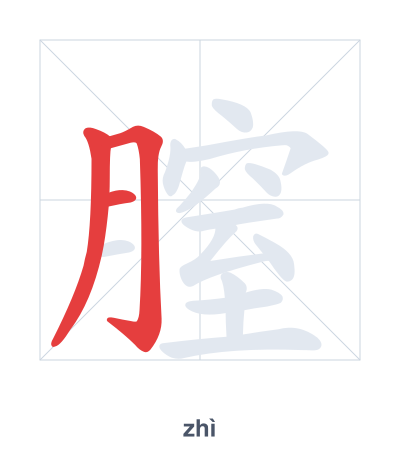
Open Hanzi Writer to see the animated stroke order and practice writing 膣 with real-time feedback.
The character 膣 (zhì) is written with 15 strokes. Follow the standard Chinese stroke order: top to bottom, left to right, outside before inside. The radical 月 is one of its key components.
Practice the correct stroke order with the Hanzi Writer app to see animated stroke-by-stroke guidance with real-time feedback.
膣 means vagina (anatomical term).
膣 is a semantic-phonetic compound: the radical 月 (flesh/body) indicates it's a body part, while 室 (shì, meaning 'room' or 'chamber') provides the sound and hints at the meaning of a cavity or inner space. This character literally depicts the vagina as a 'flesh chamber' within the body.
💡 Memory Tip: Picture a fleshy room (室) inside the body (月) where a tiny person is knocking on the door, saying 'Let me in!' — that's the vagina.
这种药治疗膣炎。
zhè zhǒng yào zhì liáo zhì yán
This medicine treats vaginitis.
医生在检查膣道。
yī shēng zài jiǎn chá zhì dào
The doctor is examining the vaginal canal.
膣壁组织很薄。
zhì bì zǔ zhī hěn báo
The vaginal wall tissue is very thin.
Open Hanzi Writer to see the animated stroke order and practice writing 膣 with real-time feedback.
✨ Animated stroke order · Handwriting recognition · HSK-graded practice · Free to use
The left side is the radical 月, which stands for flesh or body parts. The right side is 室 (shì), meaning "room." Together, they suggest "a room in the body," which refers to the vagina.