蜇 (zhē) means "To sting" in Chinese. It has 13 strokes with the radical 虫.
Rated 4.2/5 in difficulty (advanced).
Appears in 3+ common words including 蜇人 (zhē rén), 被蜇 (bèi zhē), 海蜇 (hǎi zhē).
Due to its 13 strokes, Hanzi Writer's error detection shows 蜇 requires focused practice — most learners need 10+ attempts for consistent accuracy.
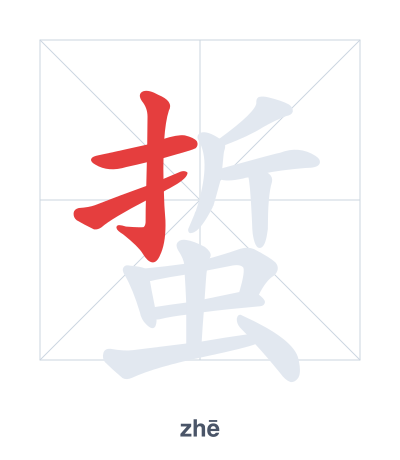
Open Hanzi Writer to see the animated stroke order and practice writing 蜇 with real-time feedback.
The character 蜇 (zhē) is written with 13 strokes. Follow the standard Chinese stroke order: top to bottom, left to right, outside before inside. The radical 虫 is one of its key components.
Practice the correct stroke order with the Hanzi Writer app to see animated stroke-by-stroke guidance with real-time feedback.
蜇 means To sting.
蜇 is a phono-semantic compound combining the radical 虫 (insect) with the phonetic component 折 (zhé, meaning 'to break' or 'bend'). The insect radical indicates the action relates to bugs like bees or scorpions, while 折 visually suggests the sharp, piercing motion of a stinger breaking the skin.
💡 Memory Tip: Picture a bee (虫) that snaps its stinger (like 折 breaking) into your arm—ouch, it stings!
这种蜂会蜇人。
zhè zhǒng fēng huì zhē rén
This bee can sting people.
我的手被蜇了。
wǒ de shǒu bèi zhē le
My hand got stung.
我喜欢吃凉拌海蜇。
wǒ xǐ huān chī liáng bàn hǎi zhē
I like eating cold jellyfish salad.
Open Hanzi Writer to see the animated stroke order and practice writing 蜇 with real-time feedback.
✨ Animated stroke order · Handwriting recognition · HSK-graded practice · Free to use
蜇 combines the radical 虫 (insect) on top and the phonetic component 折 (zhé, to break) underneath. The insect radical hints at stinging creatures like bees or jellyfish, while 折 provides a clue to the pronunciation zhē. Together, they suggest an insect's action that causes a breaking or piercing sensation.