蚯 (qiū) means "Earthworm (character component)" in Chinese. It has 11 strokes with the radical 虫.
Rated 4.2/5 in difficulty (advanced).
Appears in 3+ common words including 蚯蚓 (qiū yǐn), 蚯蚓爬 (qiū yǐn pá), 蚯蚓粪 (qiū yǐn fèn).
Due to its 11 strokes, Hanzi Writer's error detection shows 蚯 requires focused practice — most learners need 10+ attempts for consistent accuracy.
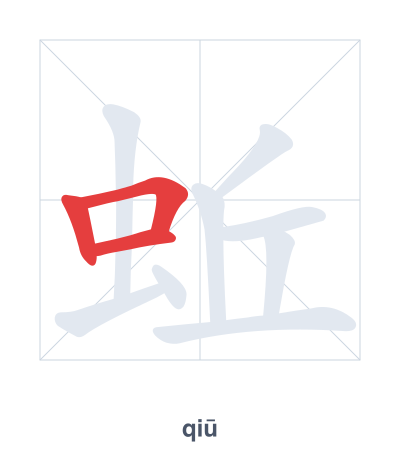
Open Hanzi Writer to see the animated stroke order and practice writing 蚯 with real-time feedback.
The character 蚯 (qiū) is written with 11 strokes. Follow the standard Chinese stroke order: top to bottom, left to right, outside before inside. The radical 虫 is one of its key components.
Practice the correct stroke order with the Hanzi Writer app to see animated stroke-by-stroke guidance with real-time feedback.
蚯 means Earthworm (character component).
蚯 combines the insect radical 虫 (worm) with 丘 (hill), indicating a worm that lives in soil or hills. The component 丘 also gives a phonetic hint for the pronunciation qiū.
💡 Memory Tip: Picture a worm (虫) wriggling out of a small hill (丘) — that's the earthworm 蚯.
土里有一条蚯蚓。
tǔ lǐ yǒu yī tiáo qiū yǐn
There is an earthworm in the soil.
蚯蚓在地上爬。
qiū yǐn zài dì shàng pá
The earthworm is crawling on the ground.
蚯蚓粪可以当肥料。
qiū yǐn fèn kě yǐ dāng féi liào
Earthworm castings can be used as fertilizer.
Open Hanzi Writer to see the animated stroke order and practice writing 蚯 with real-time feedback.
✨ Animated stroke order · Handwriting recognition · HSK-graded practice · Free to use
蚯 is made of two parts: the radical 虫 (insect or worm) on the left, and the component 丘 (hill) on the right. Together, they suggest a worm that lives in hills or soil, which fits the earthworm. The 虫 radical confirms it is a type of worm, while 丘 hints at its underground habitat.