痄 (zhà) means "mumps" in Chinese. It has 10 strokes with the radical 疒.
Rated 4.2/5 in difficulty (advanced).
Appears in 3+ common words including 痄腮 (zhà sāi), 患痄 (huàn zhà), 痄腮炎 (zhà sāi yán).
Due to its 10 strokes, Hanzi Writer's error detection shows 痄 requires focused practice — most learners need 10+ attempts for consistent accuracy.
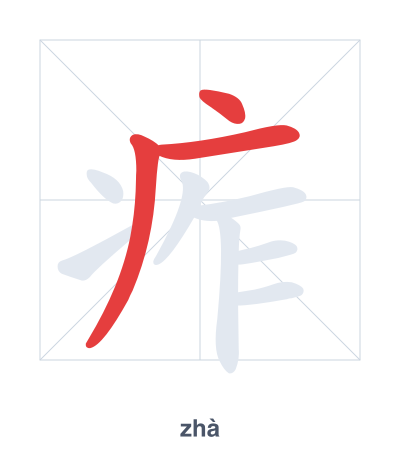
Open Hanzi Writer to see the animated stroke order and practice writing 痄 with real-time feedback.
The character 痄 (zhà) is written with 10 strokes. Follow the standard Chinese stroke order: top to bottom, left to right, outside before inside. The radical 疒 is one of its key components.
Practice the correct stroke order with the Hanzi Writer app to see animated stroke-by-stroke guidance with real-time feedback.
痄 means mumps.
The character 痄 combines the radical 疒 (illness) with the phonetic component 乍 (zhà, meaning 'suddenly' or 'first time'). The 疒 radical indicates that this character relates to a disease, while 乍 hints at the sudden onset of swelling characteristic of mumps (腮腺炎).
💡 Memory Tip: Imagine someone suddenly (乍) gets sick (疒) with a swollen cheek like a hamster storing food—that's mumps.
那个小孩得了痄腮。
nà ge xiǎo hái dé le zhà sāi
That child has the mumps.
他不幸患痄了。
tā bù xìng huàn zhà le
He unfortunately caught the mumps.
痄腮炎需要休息。
zhà sāi yán xū yào xiū xī
Mumps requires rest.
Open Hanzi Writer to see the animated stroke order and practice writing 痄 with real-time feedback.
✨ Animated stroke order · Handwriting recognition · HSK-graded practice · Free to use
痄 combines the radical 疒 (sickness) on the left and the phonetic component 乍 (zhà) on the right. The radical shows it is a disease, while 乍 suggests the sudden onset often associated with mumps.