肮 (āng) means "dirty; filthy" in Chinese. It has 8 strokes with the radical 月.
Rated 3.7/5 in difficulty (challenging).
Appears in 3+ common words including 肮脏 (āng zāng), 肮脏话 (āng zāng huà), 肮脏事 (āng zāng shì).
Due to its 8 strokes, Hanzi Writer's error detection shows 肮 requires focused practice — most learners need 10+ attempts for consistent accuracy.
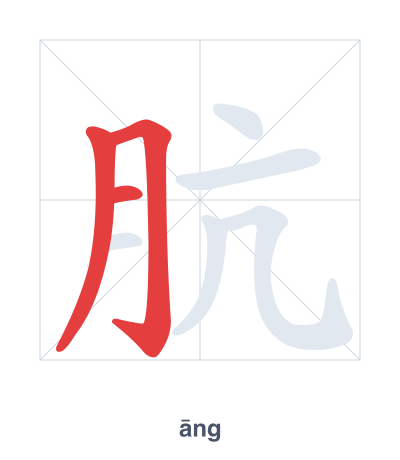
Open Hanzi Writer to see the animated stroke order and practice writing 肮 with real-time feedback.
The character 肮 (āng) is written with 8 strokes. Follow the standard Chinese stroke order: top to bottom, left to right, outside before inside. The radical 月 is one of its key components.
Practice the correct stroke order with the Hanzi Writer app to see animated stroke-by-stroke guidance with real-time feedback.
肮 means dirty; filthy.
This is a phono-semantic compound where the radical 月 (flesh) originally indicated a body part, and 亢 provides the pronunciation āng. The character was later borrowed to mean 'dirty', a meaning that has no direct visual connection to its components.
💡 Memory Tip: Picture a piece of greasy meat (月) left too high (亢) on a shelf, covered in filth and dust.
这里的地面很肮脏。
zhè lǐ de dì miàn hěn āng zāng
The ground here is very dirty.
不要说肮脏话。
bú yào shuō āng zāng huà
Don't use foul language.
他做了很多肮脏事。
tā zuò le hěn duō āng zāng shì
He did many dirty things.
Open Hanzi Writer to see the animated stroke order and practice writing 肮 with real-time feedback.
✨ Animated stroke order · Handwriting recognition · HSK-graded practice · Free to use
The character 肮 is made of two parts: the left side is the radical "月" (meat/flesh) and the right side is "亢" (kàng, meaning high or overbearing). The radical "月" connects to the body or flesh, suggesting something physically unclean, while "亢" adds the sound element and a sense of excess.