栽 (zāi) means "to plant; to fall" in Chinese. It has 10 strokes with the radical 木, and is HSK Level 7.
Rated 4.2/5 in difficulty (advanced).
Harder than 63% of HSK Level 7 characters.
Appears in 3+ common words including 栽树 (zāi shù), 栽花 (zāi huā), 栽跟头 (zāi gēn tou).
Due to its 10 strokes, Hanzi Writer's error detection shows 栽 requires focused practice — most learners need 10+ attempts for consistent accuracy.
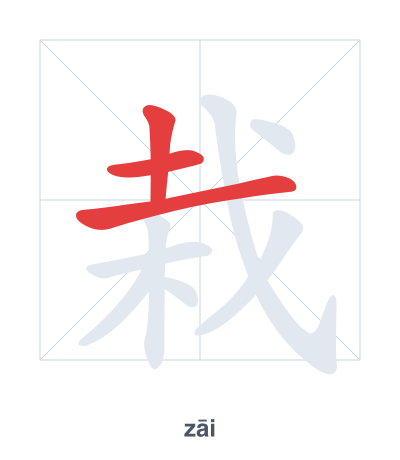
Open Hanzi Writer to see the animated stroke order and practice writing 栽 with real-time feedback.
The character 栽 (zāi) is written with 10 strokes. Follow the standard Chinese stroke order: top to bottom, left to right, outside before inside. The radical 木 is one of its key components.
Practice the correct stroke order with the Hanzi Writer app to see animated stroke-by-stroke guidance with real-time feedback.
栽 means to plant; to fall.
As an HSK Level 7 character, 栽 is an intermediate-level character.
栽 is a phono-semantic compound: the left side 木 (tree) indicates the meaning 'to plant', while the right side 𢦏 (zāi) provides the sound and originally depicted a halberd cutting, implying the action of inserting a seedling into the ground. This combination evokes the image of planting a tree by cutting a branch or sticking it into soil. The secondary meaning 'to fall' comes from the idea of something toppling over, like a newly planted sapling that hasn't taken root.
💡 Memory Tip: Picture a tree (木) that you plant, but a falling person (the right side looks like a figure with a hat 十 and a leg 戈) trips and falls into the hole you dug for the sapling.
我们在公园里栽树。
wǒ men zài gōng yuán lǐ zāi shù
We are planting trees in the park.
奶奶在院子里栽花。
nǎi nǎi zài yuàn zi lǐ zāi huā
Grandma is planting flowers in the yard.
他由于跑得太急,在台阶处不小心栽跟头了。
tā yóu yú pǎo dé tài jí , zài tái jiē chù bù xiǎo xīn zāi gēn tou le 。
Because he was running too fast, he accidentally tripped on the steps.
Open Hanzi Writer to see the animated stroke order and practice writing 栽 with real-time feedback.
✨ Animated stroke order · Handwriting recognition · HSK-graded practice · Free to use
The character 栽 is made of the radical 木 (wood/tree) on top and a component resembling 戉 (a weapon or tool) below. The tree radical connects to the meaning "to plant" (e.g., planting trees), while the lower part originally suggested cutting or falling, which relates to the meaning "to fall."