阈 (yù) means "threshold" in Chinese. It has 11 strokes with the radical 门.
Rated 4.2/5 in difficulty (advanced).
Appears in 3+ common words including 阈值 (yù zhí), 听阈 (tīng yù), 视阈 (shì yù).
Due to its 11 strokes, Hanzi Writer's error detection shows 阈 requires focused practice — most learners need 10+ attempts for consistent accuracy.
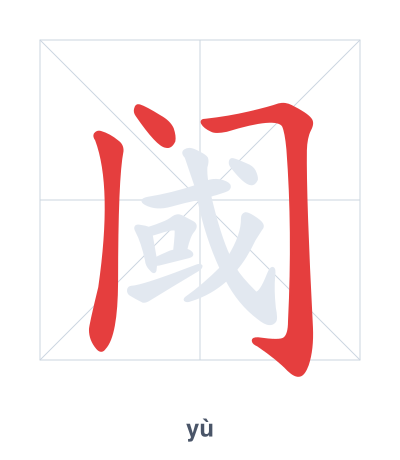
Open Hanzi Writer to see the animated stroke order and practice writing 阈 with real-time feedback.
The character 阈 (yù) is written with 11 strokes. Follow the standard Chinese stroke order: top to bottom, left to right, outside before inside. The radical 门 is one of its key components.
Practice the correct stroke order with the Hanzi Writer app to see animated stroke-by-stroke guidance with real-time feedback.
阈 means threshold.
阈 is a phono-semantic compound: the radical 门 (door) hints at its meaning related to entryways, while 或 (originally meaning 'a place with walls') provides the pronunciation and reinforces the idea of a boundary. The character depicts the threshold—the wooden plank at the bottom of a door that marks the transition between inside and outside.
💡 Memory Tip: Picture a door (门) with a horizontal wooden barrier (the 或 shape) across the bottom that you must step over—that's the threshold.
这个数值超过了阈值。
zhè ge shù zhí chāo guò le yù zhí
This value has exceeded the threshold.
每个人的听阈都不一样。
měi gè rén de tīng yù dōu bù yí yàng
Everyone's hearing threshold is different.
这开阔了我们的视阈。
zhè kāi kuò le wǒ men de shì yù
This broadened our horizons.
Open Hanzi Writer to see the animated stroke order and practice writing 阈 with real-time feedback.
✨ Animated stroke order · Handwriting recognition · HSK-graded practice · Free to use
阈 is made of the radical 门 (door/gate) on the outside and 或 (or; some) on the inside. The door suggests a physical entrance or boundary, while 或 adds the idea of a conditional point, together forming the concept of a threshold—the limit or point where something begins.