蜮 (yù) means "Mythical sand-spitting creature" in Chinese. It has 14 strokes with the radical 虫.
Rated 4.2/5 in difficulty (advanced).
Appears in 3+ common words including 鬼蜮 (guǐ yù), 蜮虫 (yù chóng), 蜮毒 (yù dú).
Due to its 14 strokes, Hanzi Writer's error detection shows 蜮 requires focused practice — most learners need 10+ attempts for consistent accuracy.
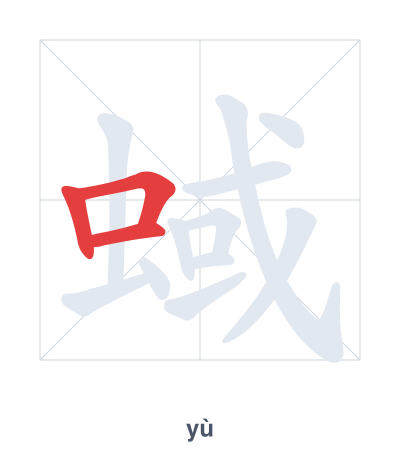
Open Hanzi Writer to see the animated stroke order and practice writing 蜮 with real-time feedback.
The character 蜮 (yù) is written with 14 strokes. Follow the standard Chinese stroke order: top to bottom, left to right, outside before inside. The radical 虫 is one of its key components.
Practice the correct stroke order with the Hanzi Writer app to see animated stroke-by-stroke guidance with real-time feedback.
蜮 means Mythical sand-spitting creature.
蜮 is a phono-semantic compound: the radical 虫 (insect/creature) indicates it is a type of animal, while 或 (huò) provides the sound and also hints at 'somewhere'—the mythical sand-spitting creature was said to hide in water and ambush people, embodying a lurking 'somewhere' threat.
💡 Memory Tip: Picture a giant insect (虫) hiding in water, ready to 'or' (或) spit sand at you—a secret 'yu' (蜮) ambush!
他的心思很鬼蜮。
tā de xīn sī hěn guǐ yù
His mind is very treacherous.
这种蜮虫很少见。
zhè zhǒng yù chóng hěn shǎo jiàn
This mythical insect is very rare.
这种蜮毒很厉害。
zhè zhǒng yù dú hěn lì hài
The venom of this creature is very potent.
Open Hanzi Writer to see the animated stroke order and practice writing 蜮 with real-time feedback.
✨ Animated stroke order · Handwriting recognition · HSK-graded practice · Free to use
蜮 is composed of the radical 虫 (insect/creature) on the left and the phonetic component 或 (huò) on the right. The 虫 radical indicates this character refers to a type of creature, while 或 provides the pronunciation. Together, they represent a mythical sand-spitting creature from ancient Chinese folklore.