Hanzi Writer

How to Write 圄 (yǔ) — Meaning “Prison / To imprison”

10 strokes Radical: 囗

圄 (yǔ) means "Prison / To imprison" in Chinese. It has 10 strokes with the radical 囗.

Rated 4.2/5 in difficulty (advanced).

Appears in 3+ common words including 囹圄 (líng yǔ), 圄中 (yǔ zhōng), 圄闭 (yǔ bì).

Due to its 10 strokes, Hanzi Writer's error detection shows 圄 requires focused practice — most learners need 10+ attempts for consistent accuracy.
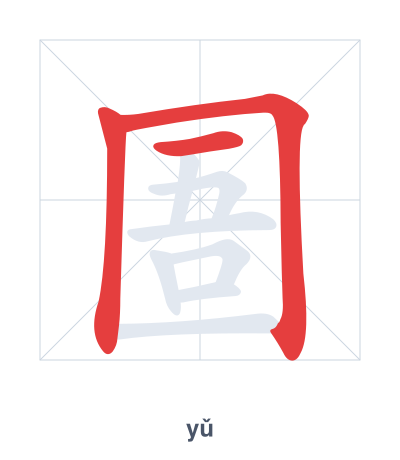
Stroke order practice for 圄 - yǔ

Practice Writing 圄 (yǔ)

Open Hanzi Writer to see the animated stroke order and practice writing 圄 with real-time feedback.

The character (yǔ) is written with 10 strokes. Follow the standard Chinese stroke order: top to bottom, left to right, outside before inside. The radical is one of its key components.

Practice the correct stroke order with the Hanzi Writer app to see animated stroke-by-stroke guidance with real-time feedback.

means Prison / To imprison.

Character
Pinyinyǔ (yu)
MeaningPrison / To imprison
Strokes10
Radical
Difficulty4.2/5

圄 is a compound character combining 囗 (enclosure) and 吾 (wú, 'I/me'), where 囗 provides the meaning of confinement and 吾 serves as a phonetic component. The character originally depicted a guarded enclosure where prisoners were held, reflecting its meaning of 'prison' or 'to imprison'.

💡 Memory Tip: Picture yourself (吾) trapped inside a square enclosure (囗) with no way out—that's prison.

líng yǔ
Prison / Jail
yǔ zhōng
In prison
yǔ bì
To imprison / To confine

他身陷囹圄。

tā shēn xiàn líng yǔ

He is behind bars.

他在圄中生活。

tā zài yǔ zhōng shēng huó

He is living in prison.

门窗被圄闭了。

mén chuāng bèi yǔ bì le

The doors and windows were closed off.

Character Pinyin Strokes Radical
(current) 10
qūn 8
líng 8
8
Stroke order practice for 圄 - yǔ

Practice Writing 圄 (yǔ)

Open Hanzi Writer to see the animated stroke order and practice writing 圄 with real-time feedback.

✨ Animated stroke order · Handwriting recognition · HSK-graded practice · Free to use

Frequently Asked Questions about 圄

The character 圄 is made of the radical 囗 (enclosure) on the outside and 吾 (wú, meaning 'I' or 'my') on the inside. The outer 囗 suggests a confined space like a prison, while 吾 provides the pronunciation and hints at a person being confined. Together, they create the idea of 'a place where a person is enclosed,' i.e., a prison.

Characters with Radical 囗

Other 10-Stroke Characters