囹 (líng) means "Prison / Enclosure" in Chinese. It has 8 strokes with the radical 囗.
Rated 3.7/5 in difficulty (challenging).
Appears in 3+ common words including 囹圄 (líng yǔ), 囹圄之苦 (líng yǔ zhī kǔ), 囹圄之灾 (líng yǔ zhī zāi).
Due to its 8 strokes, Hanzi Writer's error detection shows 囹 requires focused practice — most learners need 10+ attempts for consistent accuracy.
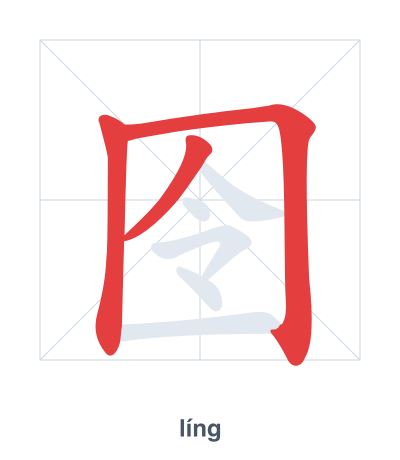
Open Hanzi Writer to see the animated stroke order and practice writing 囹 with real-time feedback.
The character 囹 (líng) is written with 8 strokes. Follow the standard Chinese stroke order: top to bottom, left to right, outside before inside. The radical 囗 is one of its key components.
Practice the correct stroke order with the Hanzi Writer app to see animated stroke-by-stroke guidance with real-time feedback.
囹 means Prison / Enclosure.
This character is a phono-semantic compound: the outer enclosure (囗) signifies a confined space, while the inner component 令 (originally 'command') provides the sound and suggests a place where orders are enforced, i.e., a prison.
💡 Memory Tip: Picture a stern commander (令) locked inside a square cell (囗), shouting orders that no one can escape.
他身陷囹圄。
tā shēn xiàn líng yǔ
He is behind bars.
他受尽了囹圄之苦。
tā shòu jǐn le líng yǔ zhī kǔ
He suffered the hardships of imprisonment.
他免受了囹圄之灾。
tā miǎn shòu le líng yǔ zhī zāi
He was spared the ordeal of being imprisoned.
Open Hanzi Writer to see the animated stroke order and practice writing 囹 with real-time feedback.
✨ Animated stroke order · Handwriting recognition · HSK-graded practice · Free to use
The character 囹 is made of the radical 囗 (enclosure) on the outside and 令 (command) on the inside. The outer 囗 gives the idea of an enclosed space, while the inner 令 provides the sound líng and hints at being under orders — together they suggest a place of confinement like a prison.