俣 (yǔ) means "big; large (literary)" in Chinese. It has 9 strokes with the radical 亻.
Rated 3.7/5 in difficulty (challenging).
Appears in 3+ common words including 俣俣 (yǔ yǔ), 硕人俣俣 (shuò rén yǔ yǔ), 俣大 (yǔ dà).
Due to its 9 strokes, Hanzi Writer's error detection shows 俣 requires focused practice — most learners need 10+ attempts for consistent accuracy.
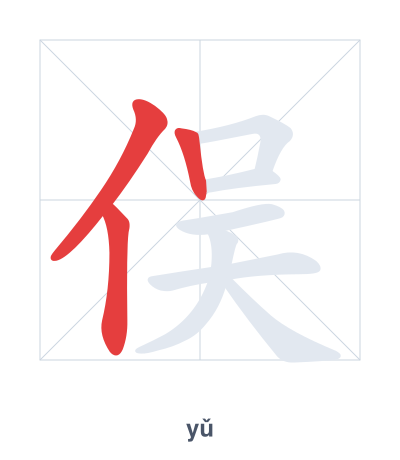
Open Hanzi Writer to see the animated stroke order and practice writing 俣 with real-time feedback.
The character 俣 (yǔ) is written with 9 strokes. Follow the standard Chinese stroke order: top to bottom, left to right, outside before inside. The radical 亻 is one of its key components.
Practice the correct stroke order with the Hanzi Writer app to see animated stroke-by-stroke guidance with real-time feedback.
俣 means big; large (literary).
俣 is a compound character with the person radical 亻 and the phonetic component 吴 (wú). Originally, 吴 also carried the meaning of 'big' or 'large,' so together they depict a person of great stature, used in literary contexts for 'big.'
💡 Memory Tip: Picture a person (亻) with a huge mouth (吴 contains 口) shouting 'WOOO!' to exaggerate their massive size.
他的身材很俣俣。
tā de shēn cái hěn yǔ yǔ
His figure is very tall and big.
硕人俣俣,公庭万舞。
shuò rén yǔ yǔ gōng tíng wàn wǔ
The tall man is sturdy, performing the dance in the court.
这个人长得俣大。
zhè ge rén zhǎng dé yǔ dà
This person is tall and big in stature.
Open Hanzi Writer to see the animated stroke order and practice writing 俣 with real-time feedback.
✨ Animated stroke order · Handwriting recognition · HSK-graded practice · Free to use
俣 combines the radical 亻 (person) on the left with 吴 (wú, a surname or ancient state) on the right. The person radical suggests a human figure, while 吴 here provides pronunciation and adds the idea of something large or grand. Together the character means "big" or "large," often used to describe a person's stature.