馀 (yú) means "Remainder / surplus" in Chinese. It has 10 strokes with the radical 饣.
Rated 4.2/5 in difficulty (advanced).
Appears in 3+ common words including 剩余 (shèng yú), 课余 (kè yú), 业余 (yè yú).
Due to its 10 strokes, Hanzi Writer's error detection shows 馀 requires focused practice — most learners need 10+ attempts for consistent accuracy.
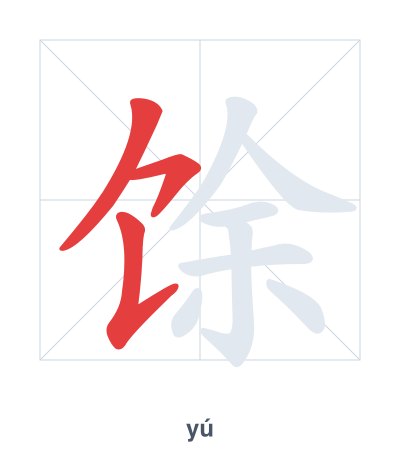
Open Hanzi Writer to see the animated stroke order and practice writing 馀 with real-time feedback.
The character 馀 (yú) is written with 10 strokes. Follow the standard Chinese stroke order: top to bottom, left to right, outside before inside. The radical 饣 is one of its key components.
Practice the correct stroke order with the Hanzi Writer app to see animated stroke-by-stroke guidance with real-time feedback.
馀 means Remainder / surplus.
This compound character combines 饣 (food radical) with 余 (meaning 'surplus' or 'I'), originally depicting leftover food or an excess of provisions. Over time, its meaning broadened from 'surplus food' to any remainder or extra amount.
💡 Memory Tip: Picture a plate of food (饣) with extra portions piled up, because you have too much—that's the surplus (余).
这里有剩余的菜。
zhè lǐ yǒu shèng yú de cài
There are leftovers here.
他课余时间学中文。
tā kè yú shí jiān xué zhōng wén
He studies Chinese in his spare time.
他是业余歌手。
tā shì yè yú gē shǒu
He is an amateur singer.
Open Hanzi Writer to see the animated stroke order and practice writing 馀 with real-time feedback.
✨ Animated stroke order · Handwriting recognition · HSK-graded practice · Free to use
馀 is composed of the left radical 饣 (food) and the right component 余 (meaning 'surplus' or 'I'). The radical 饣 suggests food or eating, while 余 hints at the idea of leftover or extra, together forming the concept of 'remainder' or 'surplus' in a concrete sense.