缨 (yīng) means "Tassel; ribbon; chin strap" in Chinese. It has 14 strokes with the radical 纟.
Rated 4.2/5 in difficulty (advanced).
Appears in 3+ common words including 红缨 (hóng yīng), 帽缨 (mào yīng), 缨络 (yīng luò).
Due to its 14 strokes, Hanzi Writer's error detection shows 缨 requires focused practice — most learners need 10+ attempts for consistent accuracy.
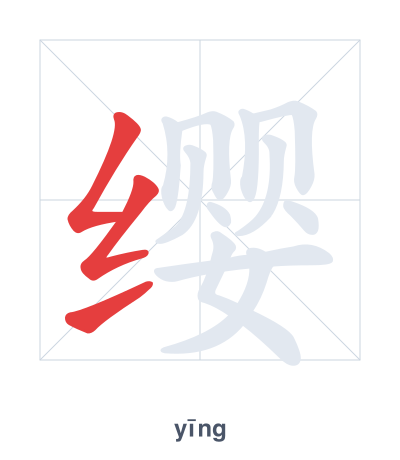
Open Hanzi Writer to see the animated stroke order and practice writing 缨 with real-time feedback.
The character 缨 (yīng) is written with 14 strokes. Follow the standard Chinese stroke order: top to bottom, left to right, outside before inside. The radical 纟 is one of its key components.
Practice the correct stroke order with the Hanzi Writer app to see animated stroke-by-stroke guidance with real-time feedback.
缨 means Tassel; ribbon; chin strap.
缨 is a phono-semantic compound: the left side 纟 (silk thread) indicates it relates to fabric or cords, and the right side 婴 (baby) provides the pronunciation yīng. The character originally referred to a decorative tassel or ribbon, such as the chin strap on a ceremonial cap or the dangling strings on a baby's garment.
💡 Memory Tip: Picture a baby (婴) wearing a silk ribbon (纟) as a chin strap with a fluffy tassel dangling down — that's 缨.
枪头上有一束红缨。
qiāng tóu shàng yǒu yī shù hóng yīng
There is a bunch of red tassels on the spearhead.
他的帽缨是红色的。
tā de mào yīng shì hóng sè de
His hat string is red.
这种缨络很漂亮。
zhè zhǒng yīng luò hěn piào liàng
This tasseled ornament is very beautiful.
Open Hanzi Writer to see the animated stroke order and practice writing 缨 with real-time feedback.
✨ Animated stroke order · Handwriting recognition · HSK-graded practice · Free to use
The character 缨 is composed of the radical 纟 (silk thread) on the left, which hints at its connection to fabric or string, and the phonetic component 婴 on the right. The silk radical shows that 缨 relates to something made from threads or cords, such as a tassel or ribbon, while 婴 adds the sound yīng without contributing direct meaning.