缄 (jiān) means "to seal / to close" in Chinese. It has 12 strokes with the radical 纟.
Rated 4.2/5 in difficulty (advanced).
Appears in 3+ common words including 缄默 (jiān mò), 封缄 (fēng jiān), 缄口 (jiān kǒu).
Due to its 12 strokes, Hanzi Writer's error detection shows 缄 requires focused practice — most learners need 10+ attempts for consistent accuracy.
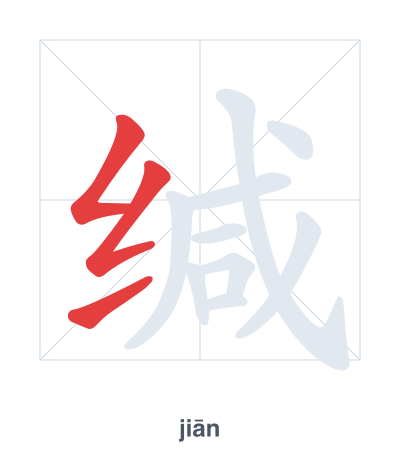
Open Hanzi Writer to see the animated stroke order and practice writing 缄 with real-time feedback.
The character 缄 (jiān) is written with 12 strokes. Follow the standard Chinese stroke order: top to bottom, left to right, outside before inside. The radical 纟 is one of its key components.
Practice the correct stroke order with the Hanzi Writer app to see animated stroke-by-stroke guidance with real-time feedback.
缄 means to seal / to close.
The character 缄 combines the silk radical 纟 (thread) with 咸 (all/entirely), which also provides the phonetic hint jiān. Ancient letters were sealed by tying a silk thread around them, so the visual form of a silk thread binding something shut conveys the meaning 'to seal or close'.
💡 Memory Tip: Imagine a silk thread (纟) wrapped tightly around a letter, sealing it with a salty (咸) wax stamp—the thread must be cut to open it.
他在会议上保持缄默。
tā zài huì yì shàng bǎo chí jiān mò
He remained silent during the meeting.
请把信封好封缄。
qǐng bǎ xìn fēng hǎo fēng jiān
Please seal the envelope.
面对问题他缄口不言。
miàn duì wèn tí tā jiān kǒu bù yán
He remained silent when faced with the problem.
Open Hanzi Writer to see the animated stroke order and practice writing 缄 with real-time feedback.
✨ Animated stroke order · Handwriting recognition · HSK-graded practice · Free to use
The character 缄 is formed by the silk radical 纟 on the left and the phonetic component 咸 on the right. The silk radical suggests binding or tying, which relates to sealing something closed. The right part 咸 also implies completeness, reinforcing the idea of making something tight or closed.