嘤 (yīng) means "whimper; chirp" in Chinese. It has 14 strokes with the radical 口.
Rated 4.2/5 in difficulty (advanced).
Appears in 3+ common words including 嘤嘤 (yīng yīng), 嘤嘤叫 (yīng yīng jiào), 嘤鸣 (yīng míng).
Due to its 14 strokes, Hanzi Writer's error detection shows 嘤 requires focused practice — most learners need 10+ attempts for consistent accuracy.
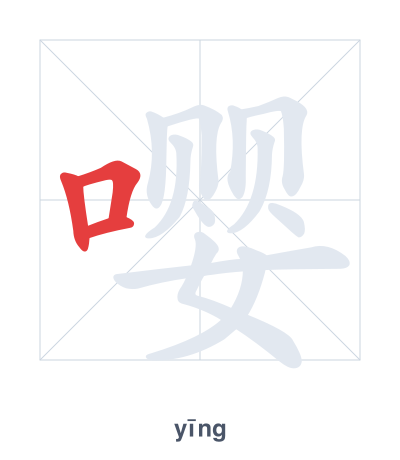
Open Hanzi Writer to see the animated stroke order and practice writing 嘤 with real-time feedback.
The character 嘤 (yīng) is written with 14 strokes. Follow the standard Chinese stroke order: top to bottom, left to right, outside before inside. The radical 口 is one of its key components.
Practice the correct stroke order with the Hanzi Writer app to see animated stroke-by-stroke guidance with real-time feedback.
嘤 means whimper; chirp.
嘤 is a phono-semantic compound: the radical 口 (mouth) indicates the character relates to sounds, while 婴 (yīng, meaning 'baby') provides the pronunciation and hints at the soft, high-pitched sounds a baby makes, such as whimpering or chirping.
💡 Memory Tip: Picture a baby (婴) opening its little mouth (口) to let out a tiny whimper or chirp.
她嘤嘤地哭了。
tā yīng yīng dì kū le
She sobbed softly.
小鸟嘤嘤叫。
xiǎo niǎo yīng yīng jiào
The little bird is warbling softly.
鸟在林中嘤鸣。
niǎo zài lín zhōng yīng míng
Birds are chirping to each other in the woods.
Open Hanzi Writer to see the animated stroke order and practice writing 嘤 with real-time feedback.
✨ Animated stroke order · Handwriting recognition · HSK-graded practice · Free to use
嘤 is composed of the radical 口 (mouth) on the left and the phonetic component 婴 (yīng, baby) on the right. The mouth radical connects the character to sounds, while 婴 suggests a high-pitched, infant-like noise, together forming the meanings of whimpering or chirping.