臆 (yì) means "chest; subjective; conjecture" in Chinese. It has 17 strokes with the radical 月.
Rated 4.2/5 in difficulty (advanced).
Appears in 3+ common words including 臆断 (yì duàn), 臆测 (yì cè), 胸臆 (xiōng yì).
Due to its 17 strokes, Hanzi Writer's error detection shows 臆 requires focused practice — most learners need 10+ attempts for consistent accuracy.
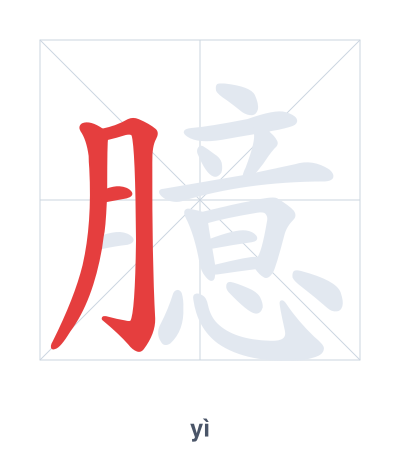
Open Hanzi Writer to see the animated stroke order and practice writing 臆 with real-time feedback.
The character 臆 (yì) is written with 17 strokes. Follow the standard Chinese stroke order: top to bottom, left to right, outside before inside. The radical 月 is one of its key components.
Practice the correct stroke order with the Hanzi Writer app to see animated stroke-by-stroke guidance with real-time feedback.
臆 means chest; subjective; conjecture.
This compound character combines the flesh radical 月 (indicating a body part) with 意 (yì, meaning 'thought' or 'intention'), suggesting the chest as the physical seat of one's inner thoughts and emotions. It literally points to the region where subjective feelings and conjectures originate.
💡 Memory Tip: Picture your chest (月) as a locked box filled with swirling, untested thoughts (意) — that's your 'subjective conjecture' before you open it to reality.
不要随便臆断他人。
bú yào suí biàn yì duàn tā rén
Don't judge others arbitrarily.
这只是他的臆测。
zhè zhǐ shì tā de yì cè
This is just his conjecture.
他直抒胸臆。
tā zhí shū xiōng yì
He spoke his mind directly.
Open Hanzi Writer to see the animated stroke order and practice writing 臆 with real-time feedback.
✨ Animated stroke order · Handwriting recognition · HSK-graded practice · Free to use
臆 is composed of the radical 月 (flesh/body) on the left and 意 (meaning; intention) on the right. The radical 月 connects to the chest, the body part that traditionally houses emotions or thoughts, while 意 provides the sound and the idea of 'thought' or 'intention'. Together, they create the meanings of 'chest' and by extension 'subjective conjecture'.