翼 (yì) means "wing" in Chinese. It has 17 strokes with the radical 羽, and is HSK Level 7.
Rated 4.2/5 in difficulty (advanced).
Harder than 82% of HSK Level 7 characters.
Appears in 3+ common words including 机翼 (jī yì), 侧翼 (cè yì), 小心翼翼 (xiǎo xīn yì yì).
Due to its 17 strokes, Hanzi Writer's error detection shows 翼 requires focused practice — most learners need 10+ attempts for consistent accuracy.
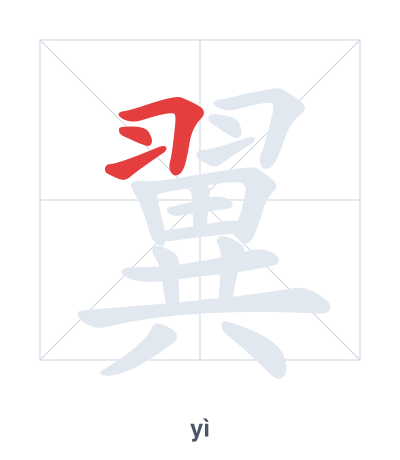
Open Hanzi Writer to see the animated stroke order and practice writing 翼 with real-time feedback.
The character 翼 (yì) is written with 17 strokes. Follow the standard Chinese stroke order: top to bottom, left to right, outside before inside. The radical 羽 is one of its key components.
Practice the correct stroke order with the Hanzi Writer app to see animated stroke-by-stroke guidance with real-time feedback.
翼 means wing.
As an HSK Level 7 character, 翼 is an intermediate-level character.
The character 翼 combines the radical 羽 (feathers) with the phonetic component 異 (yì). Its ancient form depicted the shape of a bird's wing, emphasizing the structure of flight feathers.
💡 Memory Tip: Imagine a bird with unusual (異) feathered wings (羽) that flap so hard they look like two distinct layers.
飞机的机翼很长。
fēi jī de jī yì hěn zhǎng
The wings of the plane are very long.
球队从侧翼进攻。
qiú duì cóng cè yì jìn gōng
The team is attacking from the flank.
他小心翼翼地走着。
tā xiǎo xīn yì yì dì zǒu zhe
He walked very carefully.
Open Hanzi Writer to see the animated stroke order and practice writing 翼 with real-time feedback.
✨ Animated stroke order · Handwriting recognition · HSK-graded practice · Free to use
The character 翼 combines the radical 羽 (feathers) on top with 異 (different or strange) below. The 羽 part directly suggests feathers or wings, while 異 originally may have contributed to the idea of something extending outward, like a wing. Together they create the image of a feathered appendage.