翔 (xiáng) means "soar; hover" in Chinese. It has 12 strokes with the radical 羽, and is HSK Level 7.
Rated 4.2/5 in difficulty (advanced).
Harder than 82% of HSK Level 7 characters.
Appears in 3+ common words including 飞翔 (fēi xiáng), 滑翔 (huá xiáng), 翱翔 (áo xiáng).
Due to its 12 strokes, Hanzi Writer's error detection shows 翔 requires focused practice — most learners need 10+ attempts for consistent accuracy.
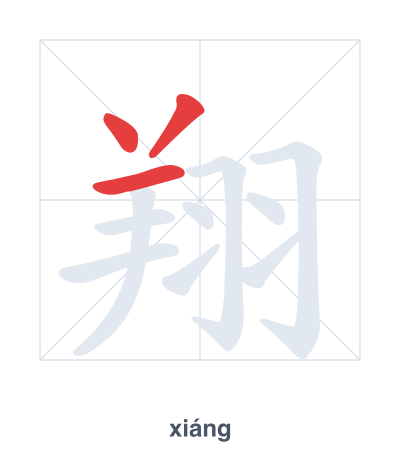
Open Hanzi Writer to see the animated stroke order and practice writing 翔 with real-time feedback.
The character 翔 (xiáng) is written with 12 strokes. Follow the standard Chinese stroke order: top to bottom, left to right, outside before inside. The radical 羽 is one of its key components.
Practice the correct stroke order with the Hanzi Writer app to see animated stroke-by-stroke guidance with real-time feedback.
翔 means soar; hover.
As an HSK Level 7 character, 翔 is an intermediate-level character.
翔 is a compound character: the radical 羽 (feathers) indicates flight, while 羊 (sheep) serves as a phonetic component. Together they evoke a bird spreading its feathered wings to glide or hover in the air.
💡 Memory Tip: Picture a sheep (羊) suddenly sprouting feathered wings (羽) and soaring effortlessly above the clouds.
雄鹰在天空飞翔。
xióng yīng zài tiān kōng fēi xiáng
The eagle flies in the sky.
他喜欢玩滑翔伞。
tā xǐ huān wán huá xiáng sǎn
He likes paragliding.
梦想让我们翱翔。
mèng xiǎng ràng wǒ men áo xiáng
Dreams let us soar.
Open Hanzi Writer to see the animated stroke order and practice writing 翔 with real-time feedback.
✨ Animated stroke order · Handwriting recognition · HSK-graded practice · Free to use
翔 is composed of two parts: the left side 羊 (sheep) and the right side 羽 (feather). The feather radical directly relates to flying and birds, while 羊 provides the pronunciation (xiáng). Together, the character means to soar or hover, like a bird using its feathers.