羿 (yì) means "Hou Yi (a legendary archer in Chinese mythology)" in Chinese. It has 9 strokes with the radical 羽.
Rated 4/5 in difficulty (challenging).
Appears in 3+ common words including 后羿 (hòu yì), 羿射 (yì shè), 羿氏 (yì shì).
Due to its 9 strokes, Hanzi Writer's error detection shows 羿 requires focused practice — most learners need 10+ attempts for consistent accuracy.
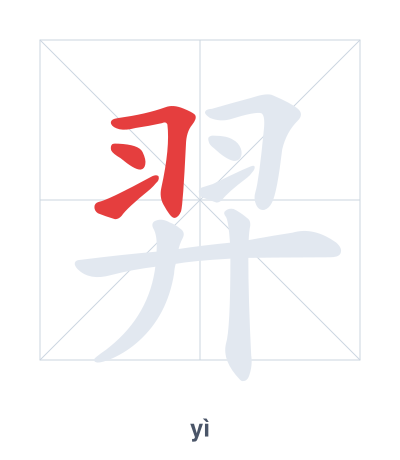
Open Hanzi Writer to see the animated stroke order and practice writing 羿 with real-time feedback.
The character 羿 (yì) is written with 9 strokes. Follow the standard Chinese stroke order: top to bottom, left to right, outside before inside. The radical 羽 is one of its key components.
Practice the correct stroke order with the Hanzi Writer app to see animated stroke-by-stroke guidance with real-time feedback.
羿 means Hou Yi (a legendary archer in Chinese mythology).
| Character | 羿 |
| Pinyin | yì (yi) |
| Meaning | Hou Yi (a legendary archer in Chinese mythology) |
| Strokes | 9 |
| Radical | 羽 |
| Difficulty | 4/5 |
羿 combines 羽 (feathers, representing arrows) and 廾 (two hands), forming an image of hands holding feathered arrows—a direct reference to the legendary archer Hou Yi.
💡 Memory Tip: Picture Hou Yi holding a feathered arrow (羽) with both hands (廾) as he aims to shoot down nine suns.
后羿射日的故事很有名。
hòu yì shè rì de gù shì hěn yǒu míng
The story of Houyi shooting the suns is very famous.
羿射九日是古代神话。
yì shè jiǔ rì shì gǔ dài shén huà
Yi shooting down nine suns is an ancient myth.
羿氏是一个古老的姓氏。
yì shì shì yí gè gǔ lǎo de xìng shì
Yi is an ancient surname.
Open Hanzi Writer to see the animated stroke order and practice writing 羿 with real-time feedback.
✨ Animated stroke order · Handwriting recognition · HSK-graded practice · Free to use
The character 羿 is composed of 羽 (feather) on top and 廾 (two hands) on the bottom. The feather represents arrows, and the two hands suggest holding a bow, together symbolizing archery — the skill of the legendary archer Hou Yi.