瘗 (yì) means "to bury; to inter" in Chinese. It has 14 strokes with the radical 疒.
Rated 4.2/5 in difficulty (advanced).
Appears in 3+ common words including 瘗埋 (yì mái), 瘗玉埋香 (yì yù mái xiāng), 瘗钱 (yì qián).
Due to its 14 strokes, Hanzi Writer's error detection shows 瘗 requires focused practice — most learners need 10+ attempts for consistent accuracy.
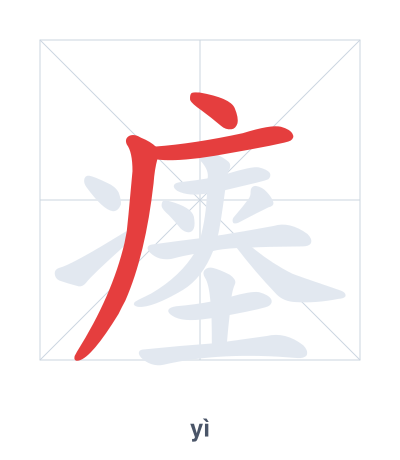
Open Hanzi Writer to see the animated stroke order and practice writing 瘗 with real-time feedback.
The character 瘗 (yì) is written with 14 strokes. Follow the standard Chinese stroke order: top to bottom, left to right, outside before inside. The radical 疒 is one of its key components.
Practice the correct stroke order with the Hanzi Writer app to see animated stroke-by-stroke guidance with real-time feedback.
瘗 means to bury; to inter.
The character 瘗 combines the radical 疒 (sickness, suggesting a corpse or sick person) with 壹 (the number one, here acting phonetically and also containing 土 'earth'). Together, they evoke the image of burying a deceased body in the earth, with the top of 壹 resembling a mound or covering.
💡 Memory Tip: Picture a sick person (疒) lying under a single (壹) mound of earth, being interred forever.
他们在这里瘗埋尸体。
tā men zài zhè lǐ yì mái shī tǐ
They buried the bodies here.
这是一个感人的故事。
zhè shì yí gè gǎn rén de gù shì
This is a touching story.
祭祀时要准备瘗钱。
jì sì shí yào zhǔn bèi yì qián
Paper money for the dead should be prepared during the sacrifice.
Open Hanzi Writer to see the animated stroke order and practice writing 瘗 with real-time feedback.
✨ Animated stroke order · Handwriting recognition · HSK-graded practice · Free to use
The character 瘗 is composed of the radical 疒 (illness) on the outside and the component 堙 (yīn, meaning to block up or fill) inside. Together, they suggest the idea of covering or filling something related to sickness or death, which connects to burying a corpse. This structure reflects the original meaning of placing a body into the earth.