Hanzi Writer

How to Write 簷 (yán) — Meaning “eaves”

yán 19 strokes Radical: 竹

簷 (yán) means "eaves" in Chinese. It has 19 strokes with the radical 竹.

Rated 4.2/5 in difficulty (advanced).

Appears in 3+ common words including 屋簷 (wū yán), 房簷 (fáng yán), 簷下 (yán xià).

Due to its 19 strokes, Hanzi Writer's error detection shows 簷 requires focused practice — most learners need 10+ attempts for consistent accuracy.
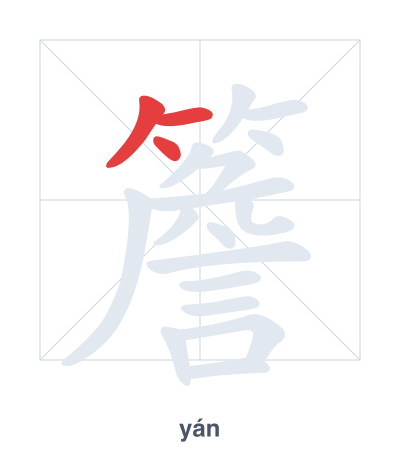
Stroke order practice for 簷 - yán

Practice Writing 簷 (yán)

Open Hanzi Writer to see the animated stroke order and practice writing 簷 with real-time feedback.

The character (yán) is written with 19 strokes. Follow the standard Chinese stroke order: top to bottom, left to right, outside before inside. The radical is one of its key components.

Practice the correct stroke order with the Hanzi Writer app to see animated stroke-by-stroke guidance with real-time feedback.

means eaves.

Character
Pinyinyán (yan)
Meaningeaves
Strokes19
Radical
Difficulty4.2/5

簷 is a compound character with the radical 竹 (bamboo) on top, indicating that eaves were often made of bamboo or bamboo mats. The lower part 檐 combines 木 (wood) and 詹 (phonetic, also suggesting a protruding edge), together forming the idea of a roof's projecting edge.

💡 Memory Tip: Imagine a bamboo mat (竹) hanging over the edge of a wooden roof (木) like a long tongue (詹 sounds like 'chatter'—the eaves 'talk' by dripping rain).

wū yán
Eaves.
fáng yán
eaves
yán xià
under the eaves

燕子在屋簷下做了一个窝。

yàn zi zài wū yán xià zuò le yí gè wō

A swallow made a nest under the eaves.

雨水顺着房簷流了下来。

yǔ shuǐ shùn zhe fáng yán liú le xià lái

Rainwater flowed down along the eaves.

我们在簷下躲雨。

wǒ men zài yán xià duǒ yǔ

We are taking shelter from the rain under the eaves.

Character Pinyin Strokes Radical
(current) yán 19
dōu 17
miè 17
17
Stroke order practice for 簷 - yán

Practice Writing 簷 (yán)

Open Hanzi Writer to see the animated stroke order and practice writing 簷 with real-time feedback.

✨ Animated stroke order · Handwriting recognition · HSK-graded practice · Free to use

Frequently Asked Questions about 簷

簷 is made of the radical 竹 (bamboo) on top and the phonetic component 簷 (yán) below, which hints at the pronunciation. The bamboo radical suggests that traditional eaves were often made from bamboo or wood, connecting the character to the overhanging edge of a roof.

Characters with Radical 竹

Other 19-Stroke Characters