筵 (yán) means "bamboo mat; feast" in Chinese. It has 12 strokes with the radical 竹.
Rated 4.2/5 in difficulty (advanced).
Appears in 3+ common words including 筵席 (yán xí), 喜筵 (xǐ yán), 寿筵 (shòu yán).
Due to its 12 strokes, Hanzi Writer's error detection shows 筵 requires focused practice — most learners need 10+ attempts for consistent accuracy.
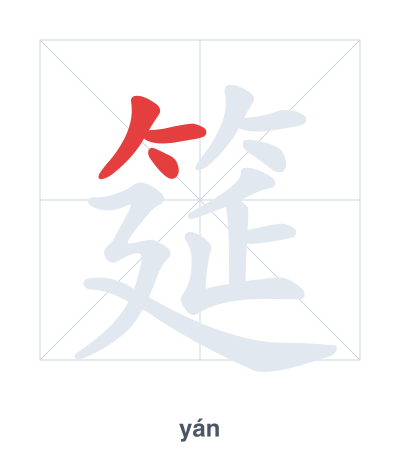
Open Hanzi Writer to see the animated stroke order and practice writing 筵 with real-time feedback.
The character 筵 (yán) is written with 12 strokes. Follow the standard Chinese stroke order: top to bottom, left to right, outside before inside. The radical 竹 is one of its key components.
Practice the correct stroke order with the Hanzi Writer app to see animated stroke-by-stroke guidance with real-time feedback.
筵 means bamboo mat; feast.
筵 combines the radical 竹 (bamboo, indicating the material) with 延 (extend, prolong), suggesting a mat that is spread out on the ground. In ancient times, such bamboo mats were used for seating during ceremonial feasts, hence the meaning of both 'bamboo mat' and 'feast'.
💡 Memory Tip: Picture a bamboo mat (竹) being extended (延) across the floor for a grand feast.
筵席上有很多菜。
yán xí shàng yǒu hěn duō cài
There are many dishes at the banquet.
他们去参加喜筵。
tā men qù cān jiā xǐ yán
They went to attend a wedding banquet.
今天是爷爷的寿筵。
jīn tiān shì yé yé de shòu yán
Today is Grandpa's birthday banquet.
Open Hanzi Writer to see the animated stroke order and practice writing 筵 with real-time feedback.
✨ Animated stroke order · Handwriting recognition · HSK-graded practice · Free to use
筵 is made of the radical 竹 (bamboo) on top and the phonetic component 延 (yán, meaning to extend) below. The bamboo radical shows that the original meaning was a bamboo mat, which was later extended to mean a feast because people sat on bamboo mats during banquets.