阉 (yān) means "to castrate" in Chinese. It has 11 strokes with the radical 门.
Rated 4.2/5 in difficulty (advanced).
Appears in 3+ common words including 阉割 (yān gē), 阉鸡 (yān jī), 阉人 (yān rén).
Due to its 11 strokes, Hanzi Writer's error detection shows 阉 requires focused practice — most learners need 10+ attempts for consistent accuracy.
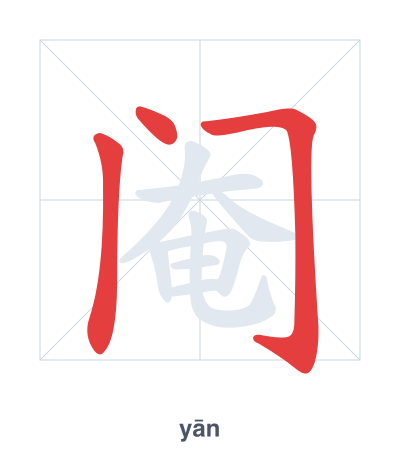
Open Hanzi Writer to see the animated stroke order and practice writing 阉 with real-time feedback.
The character 阉 (yān) is written with 11 strokes. Follow the standard Chinese stroke order: top to bottom, left to right, outside before inside. The radical 门 is one of its key components.
Practice the correct stroke order with the Hanzi Writer app to see animated stroke-by-stroke guidance with real-time feedback.
阉 means to castrate.
阉 combines the radical 门 (gate), indicating the palace where eunuchs served, with 奄 (to cover), which provides phonetic and semantic hints of suppression or cutting. Together they depict the act of castration performed to create eunuchs for the imperial court.
💡 Memory Tip: Picture a palace gate (门) where a man is covered (奄) by a sheet as he undergoes castration.
这种手术叫作阉割。
zhè zhǒng shǒu shù jiào zuò yān gē
This surgery is called castration.
农场里有很多阉鸡。
nóng chǎng lǐ yǒu hěn duō yān jī
There are many capons on the farm.
这是关于古代阉人的历史。
zhè shì guān yú gǔ dài yān rén de lì shǐ
This is a history about ancient eunuchs.
Open Hanzi Writer to see the animated stroke order and practice writing 阉 with real-time feedback.
✨ Animated stroke order · Handwriting recognition · HSK-graded practice · Free to use
阉 is composed of the radical 门 (gate/door) on the outside and 奄 (yǎn, meaning to cover or to stay) inside. The radical 门 hints at an enclosed space, while 奄 suggests covering or hiding; together they imply a closed operation, referring to castration. This structure visually depicts the concept of a confined or hidden procedure.