痖 (yǎ) means "mute; hoarse" in Chinese. It has 11 strokes with the radical 疒.
Rated 4.2/5 in difficulty (advanced).
Appears in 3+ common words including 痖巴 (yǎ bā), 聋痖 (lóng yǎ), 痖嗓 (yǎ sǎng).
Due to its 11 strokes, Hanzi Writer's error detection shows 痖 requires focused practice — most learners need 10+ attempts for consistent accuracy.
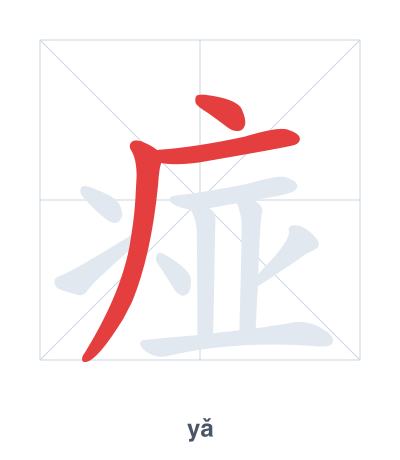
Open Hanzi Writer to see the animated stroke order and practice writing 痖 with real-time feedback.
The character 痖 (yǎ) is written with 11 strokes. Follow the standard Chinese stroke order: top to bottom, left to right, outside before inside. The radical 疒 is one of its key components.
Practice the correct stroke order with the Hanzi Writer app to see animated stroke-by-stroke guidance with real-time feedback.
痖 means mute; hoarse.
The character 痖 combines the radical 疒 (illness) with 亚 (inferior/second), suggesting a condition where illness impairs the voice, rendering it inferior or muted.
💡 Memory Tip: Imagine a sick person (疒) lying down, their speech reduced to a faint 'ah' (亚 sounds like 'ah') because they are hoarse.
他是个痖巴,不会说话。
tā shì gè yǎ bā bú huì shuō huà
He is a mute; he cannot speak.
这里有一所聋痖学校。
zhè lǐ yǒu yī suǒ lóng yǎ xué xiào
There is a school for the deaf and mute here.
他的嗓子哭痖了。
tā de sǎng zi kū yǎ le
His voice became hoarse from crying.
Open Hanzi Writer to see the animated stroke order and practice writing 痖 with real-time feedback.
✨ Animated stroke order · Handwriting recognition · HSK-graded practice · Free to use
The character 痖 combines the radical 疒 (illness) on the left with 亚 (yǎ, meaning 'second' or 'inferior') on the right. The radical suggests a health problem, while 亚 implies a weakened or reduced state, together indicating a voice that is ill or impaired — thus 'mute' or 'hoarse'.