醺 (xūn) means "tipsy; drunk" in Chinese. It has 21 strokes with the radical 酉.
Rated 4.2/5 in difficulty (advanced).
Appears in 3+ common words including 醉醺醺 (zuì xūn xūn), 微醺 (wēi xūn), 醺然 (xūn rán).
Due to its 21 strokes, Hanzi Writer's error detection shows 醺 requires focused practice — most learners need 10+ attempts for consistent accuracy.
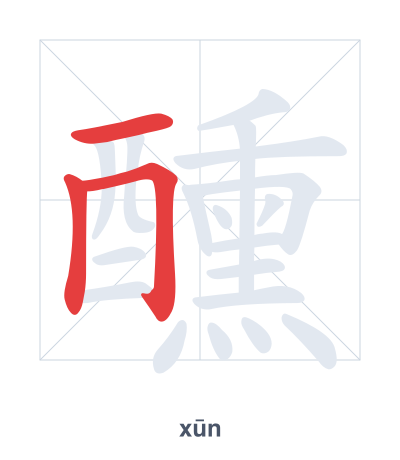
Open Hanzi Writer to see the animated stroke order and practice writing 醺 with real-time feedback.
The character 醺 (xūn) is written with 21 strokes. Follow the standard Chinese stroke order: top to bottom, left to right, outside before inside. The radical 酉 is one of its key components.
Practice the correct stroke order with the Hanzi Writer app to see animated stroke-by-stroke guidance with real-time feedback.
醺 means tipsy; drunk.
醺 combines the radical 酉 (wine jar) with the phonetic component 熏 (xūn, meaning 'smoke' or 'fumes'). The idea is that the intoxicating vapors or fumes from wine cause a person to become tipsy or drunk.
💡 Memory Tip: A wine jar (酉) releases smoky fumes (熏) that make you feel dizzy and tipsy, like inhaling too much alcohol vapor.
他喝得醉醺醺的。
tā hē dé zuì xūn xūn de
He was tipsy and drunk.
这种微醺的感觉很好。
zhè zhǒng wēi xūn de gǎn jué hěn hǎo
This tipsy feeling is very pleasant.
他满脸醺然的笑意。
tā mǎn liǎn xūn rán de xiào yì
He had a tipsy smile on his face.
Open Hanzi Writer to see the animated stroke order and practice writing 醺 with real-time feedback.
✨ Animated stroke order · Handwriting recognition · HSK-graded practice · Free to use
醺 is made of two parts: the left side 酉 (wine jar) and the right side 熏 (smoke). The wine jar hints at alcohol, while 熏 suggests the smell or haze of drinking. Together they create the idea of being tipsy or drunk from wine.