醭 (bú) means "Mold on liquids" in Chinese. It has 19 strokes with the radical 酉.
Rated 4.2/5 in difficulty (advanced).
Appears in 3+ common words including 起醭 (qǐ bú), 醋醭 (cù bú), 酱醭 (jiàng bú).
Due to its 19 strokes, Hanzi Writer's error detection shows 醭 requires focused practice — most learners need 10+ attempts for consistent accuracy.
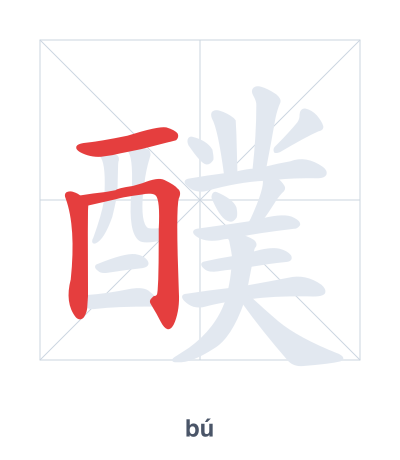
Open Hanzi Writer to see the animated stroke order and practice writing 醭 with real-time feedback.
The character 醭 (bú) is written with 19 strokes. Follow the standard Chinese stroke order: top to bottom, left to right, outside before inside. The radical 酉 is one of its key components.
Practice the correct stroke order with the Hanzi Writer app to see animated stroke-by-stroke guidance with real-time feedback.
醭 means Mold on liquids.
The left component 酉 represents a wine jar or fermented liquid, indicating the character relates to liquids. The right component 菐 (pú) originally depicted a hand covering something, here suggesting a layer or scum that spreads over the liquid's surface—hence mold on liquids. Together, they form a compound where 酉 provides the semantic context and 菐 adds the idea of a covering growth.
💡 Memory Tip: Imagine a jar of wine (酉) topped with a fuzzy green mold (菐 looks like a messy blob) that has spread across the surface—that's 醭, the mold on liquids.
这坛醋起醭了。
zhè tán cù qǐ bú le
This jar of vinegar has developed a film of mold.
醋醭是白色的。
cù bú shì bái sè de
The vinegar film is white.
酱缸里长了酱醭。
jiàng gāng lǐ zhǎng le jiàng bú
Mold has grown in the sauce jar.
Open Hanzi Writer to see the animated stroke order and practice writing 醭 with real-time feedback.
✨ Animated stroke order · Handwriting recognition · HSK-graded practice · Free to use
The left side 酉 (yǒu) means "wine jar" and represents liquids or fermentation. The right side 菐 (pú) suggests a surface covering or something spreading. Together, they show mold forming on the surface of a liquid, which is the character's meaning.