醮 (jiào) means "To dip or perform a ritual" in Chinese. It has 19 strokes with the radical 酉.
Rated 4.2/5 in difficulty (advanced).
Appears in 3+ common words including 打醮 (dǎ jiào), 再醮 (zài jiào), 醮祭 (jiào jì).
Due to its 19 strokes, Hanzi Writer's error detection shows 醮 requires focused practice — most learners need 10+ attempts for consistent accuracy.
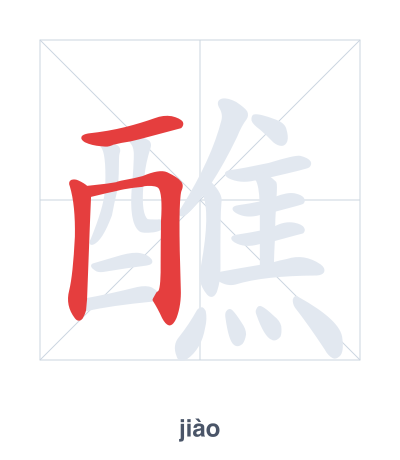
Open Hanzi Writer to see the animated stroke order and practice writing 醮 with real-time feedback.
The character 醮 (jiào) is written with 19 strokes. Follow the standard Chinese stroke order: top to bottom, left to right, outside before inside. The radical 酉 is one of its key components.
Practice the correct stroke order with the Hanzi Writer app to see animated stroke-by-stroke guidance with real-time feedback.
醮 means To dip or perform a ritual.
The character 醮 combines the radical 酉 (representing wine or ritual vessels) with 焦 as a phonetic component. It originally referred to a type of wine libation ritual where wine was poured as an offering, and later extended to mean dipping food in sauce or a Taoist sacrificial ceremony.
💡 Memory Tip: Picture a shaman holding a wine vessel (酉) while dipping a burnt bird (焦) into it as a ritual offering.
村里正在打醮。
cūn lǐ zhèng zài dǎ jiào
A Taoist sacrificial ritual is being held in the village.
她在古代选择了再醮。
tā zài gǔ dài xuǎn zé le zài jiào
She chose to remarry in ancient times.
这是一场古老的醮祭。
zhè shì yī cháng gǔ lǎo de jiào jì
This is an ancient sacrificial rite.
Open Hanzi Writer to see the animated stroke order and practice writing 醮 with real-time feedback.
✨ Animated stroke order · Handwriting recognition · HSK-graded practice · Free to use
醮 is composed of the radical 酉 (yǒu), which relates to wine or fermentation, and the phonetic component 焦 (jiāo, meaning 'burnt' or 'scorched'). Together, they suggest a ritual involving wine or offerings, often in Taoist ceremonies where something is 'burned' or offered.