谑 (xuè) means "to joke or banter" in Chinese. It has 11 strokes with the radical 讠.
Rated 3.9/5 in difficulty (challenging).
Appears in 3+ common words including 戏谑 (xì xuè), 诙谑 (huī xuè), 谑称 (xuè chēng).
Due to its 11 strokes, Hanzi Writer's error detection shows 谑 requires focused practice — most learners need 10+ attempts for consistent accuracy.
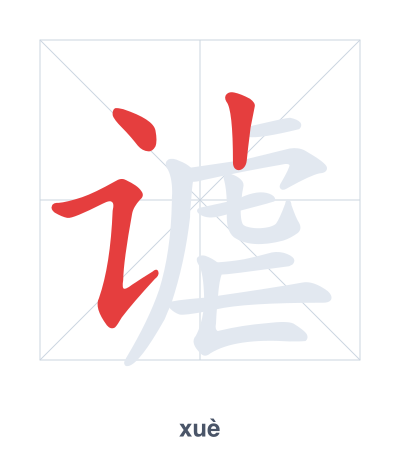
Open Hanzi Writer to see the animated stroke order and practice writing 谑 with real-time feedback.
The character 谑 (xuè) is written with 11 strokes. Follow the standard Chinese stroke order: top to bottom, left to right, outside before inside. The radical 讠 is one of its key components.
Practice the correct stroke order with the Hanzi Writer app to see animated stroke-by-stroke guidance with real-time feedback.
谑 means to joke or banter.
谑 is a compound character: the speech radical 讠 (words) plus 虐 (cruelty/tyranny). The original idea was 'to speak teasingly or mockingly,' as witty banter can have a sharp edge, like a verbal 'attack' that's playful rather than mean.
💡 Memory Tip: Imagine a tiger (虍) making a cruel joke so funny that even its prey laughs—the speech bubble (讠) shows it's all in jest.
他的语气带着戏谑。
tā de yǔ qì dài zhe xì xuè
His tone was playful.
这篇文章很诙谑。
zhè piān wén zhāng hěn huī xuè
This article is very humorous.
这是他的一个谑称。
zhè shì tā de yí gè xuè chēng
This is a playful nickname of his.
Open Hanzi Writer to see the animated stroke order and practice writing 谑 with real-time feedback.
✨ Animated stroke order · Handwriting recognition · HSK-graded practice · Free to use
谑 is made of the radical 讠 (speech) on the left and 虐 (xuè, cruel) on the right. The speech radical suggests it involves words, while 虐 gives the sound and hints at harsh teasing, together meaning 'to joke or banter' with a playful edge.