诙 (huī) means "Humorous; funny" in Chinese. It has 8 strokes with the radical 讠.
Rated 3.4/5 in difficulty (challenging).
Appears in 3+ common words including 诙谐 (huī xié), 诙谐感 (huī xié gǎn), 诙谐曲 (huī xié qū).
Due to its 8 strokes, Hanzi Writer's error detection shows 诙 requires focused practice — most learners need 10+ attempts for consistent accuracy.
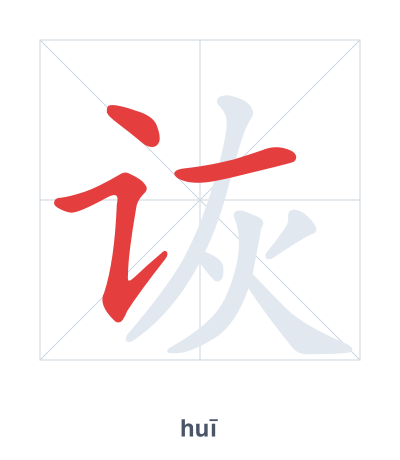
Open Hanzi Writer to see the animated stroke order and practice writing 诙 with real-time feedback.
The character 诙 (huī) is written with 8 strokes. Follow the standard Chinese stroke order: top to bottom, left to right, outside before inside. The radical 讠 is one of its key components.
Practice the correct stroke order with the Hanzi Writer app to see animated stroke-by-stroke guidance with real-time feedback.
诙 means Humorous; funny.
诙 is a phono-semantic compound where the radical 讠 (speech) indicates it relates to spoken words, and 灰 (huī, 'ash') provides the pronunciation. The idea of 'ash' suggests something trivial or light, aligning with humorous, jesting speech.
💡 Memory Tip: Imagine a comedian (讠) covered in gray ashes (灰) after a prank, making everyone laugh with his witty jokes.
他说话很诙谐。
tā shuō huà hěn huī xié
He speaks in a very witty and humorous way.
他很有诙谐感。
tā hěn yǒu huī xié gǎn
He has a great sense of humor.
这是一个诙谐曲。
zhè shì yí gè huī xié qū
This is a scherzo.
Open Hanzi Writer to see the animated stroke order and practice writing 诙 with real-time feedback.
✨ Animated stroke order · Handwriting recognition · HSK-graded practice · Free to use
诙 is made of the radical 讠 (speech) on the left and 灰 (huī, ash) on the right. The radical shows it is related to speaking or words, while 灰 provides the sound. The character means "humorous" or "funny," so it describes a type of speech that is light and entertaining.