谖 (xuān) means "to deceive or forget" in Chinese. It has 11 strokes with the radical 讠.
Rated 3.9/5 in difficulty (challenging).
Appears in 3+ common words including 谖草 (xuān cǎo), 忘谖 (wàng xuān), 永谖 (yǒng xuān).
Due to its 11 strokes, Hanzi Writer's error detection shows 谖 requires focused practice — most learners need 10+ attempts for consistent accuracy.
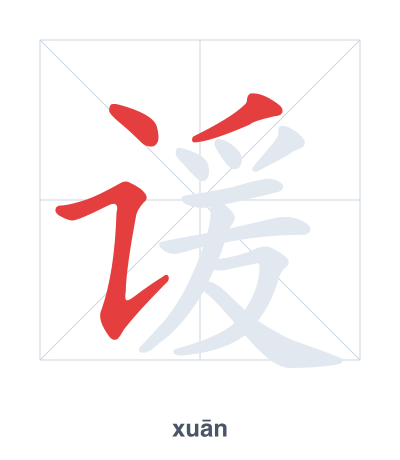
Open Hanzi Writer to see the animated stroke order and practice writing 谖 with real-time feedback.
The character 谖 (xuān) is written with 11 strokes. Follow the standard Chinese stroke order: top to bottom, left to right, outside before inside. The radical 讠 is one of its key components.
Practice the correct stroke order with the Hanzi Writer app to see animated stroke-by-stroke guidance with real-time feedback.
谖 means to deceive or forget.
谖 combines the speech radical 讠 with 爰 (yuán), which originally depicted a hand pulling a thread, implying leading or transferring. Together, they suggest words that lead someone astray or cause them to forget, hence the meanings 'deceive' and 'forget.'
💡 Memory Tip: Imagine a speaker (讠) who says, 'I'll hand over (爰) your money,' but then deceives you and forgets the promise entirely.
园子里种了谖草。
yuán zi lǐ zhǒng le xuān cǎo
Daylilies are planted in the garden.
这种花可以让人忘谖。
zhè zhòng huā kě yǐ ràng rén wàng xuān
This flower can make people forget their worries.
我们要永谖此志。
wǒ men yào yǒng xuān cǐ zhì
We must never forget this ambition.
Open Hanzi Writer to see the animated stroke order and practice writing 谖 with real-time feedback.
✨ Animated stroke order · Handwriting recognition · HSK-graded practice · Free to use
The character 谖 is made of the radical 讠, meaning "speech" or "words", and the phonetic component 爰. The speech radical suggests that the character involves spoken or written communication, while 爰 contributes to the pronunciation xuān and may hint at the idea of "drawing away" or "forgetting". Together, 谖 can mean "to deceive" (using words to mislead) or "to forget" (as if talking something out of mind).