猇 (xiāo) means "roar of a tiger" in Chinese. It has 11 strokes with the radical 犭.
Rated 4.2/5 in difficulty (advanced).
Appears in 3+ common words including 猇亭 (xiāo tíng), 猇呼 (xiāo hū), 猇然 (xiāo rán).
Due to its 11 strokes, Hanzi Writer's error detection shows 猇 requires focused practice — most learners need 10+ attempts for consistent accuracy.
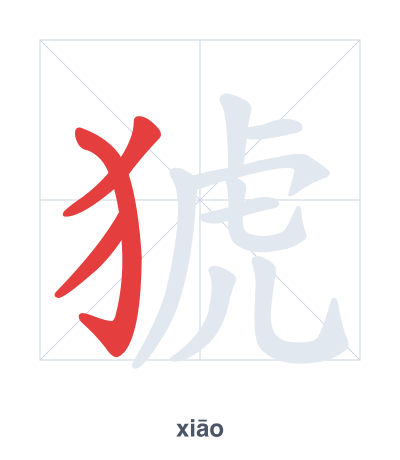
Open Hanzi Writer to see the animated stroke order and practice writing 猇 with real-time feedback.
The character 猇 (xiāo) is written with 11 strokes. Follow the standard Chinese stroke order: top to bottom, left to right, outside before inside. The radical 犭 is one of its key components.
Practice the correct stroke order with the Hanzi Writer app to see animated stroke-by-stroke guidance with real-time feedback.
猇 means roar of a tiger.
The character 猇 combines the animal radical 犭 (dog/beast) with 虎 (tiger) as a sound component, suggesting the fierce roar of a tiger. It is a compound character where the radical hints at a beast and the phonetic part indicates the tiger itself, together evoking a tiger's roar.
💡 Memory Tip: Picture a tiger (虎) with a loudspeaker (犭 as a distorted microphone) roaring so fiercely that the sound waves shake the ground.
猇亭是一个地名。
xiāo tíng shì yí gè dì míng
Xiaoting is a place name.
老虎发出猇呼声。
lǎo hǔ fā chū xiāo hū shēng
The tiger let out a roar.
它的样子很猇然。
tā de yàng zi hěn xiāo rán
It looks very fierce, like a roaring tiger.
Open Hanzi Writer to see the animated stroke order and practice writing 猇 with real-time feedback.
✨ Animated stroke order · Handwriting recognition · HSK-graded practice · Free to use
猇 is made of the animal radical 犭 on the left and the character 虎 (tiger) on the right. The left part indicates an animal, and the right part specifies the tiger, so together they suggest the roar of a tiger.