线 (xiàn) means "line, thread, wire" in Chinese. It has 8 strokes with the radical 纟, and is HSK Level 3.
Rated 3.7/5 in difficulty (challenging).
Harder than 52% of HSK Level 3 characters.
Appears in 3+ common words including 毛线 (máo xiàn), 直线 (zhí xiàn), 路线 (lù xiàn).
Due to its 8 strokes, Hanzi Writer's error detection shows 线 requires focused practice — most learners need 10+ attempts for consistent accuracy.
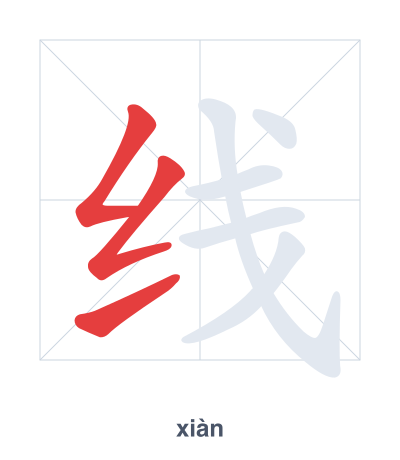
Open Hanzi Writer to see the animated stroke order and practice writing 线 with real-time feedback.
The character 线 (xiàn) is written with 8 strokes. Follow the standard Chinese stroke order: top to bottom, left to right, outside before inside. The radical 纟 is one of its key components.
Practice the correct stroke order with the Hanzi Writer app to see animated stroke-by-stroke guidance with real-time feedback.
线 means line, thread, wire.
As an HSK Level 3 character, 线 is an intermediate-level character.
线 is a phono-semantic compound: the left radical 纟 (silk) indicates thread or fiber, while the right component 戋 (jiān) originally meant 'small' or 'thin' and also provides a phonetic clue. The character thus visually represents a thin, delicate strand of silk, evolving into the general meaning of line, thread, or wire.
💡 Memory Tip: Picture a tiny silk thread (纟) that is so thin it barely shows up next to two tiny crossed swords (戋) — that slender line is the 线.
奶奶在织毛线衣。
nǎi nǎi zài zhī máo xiàn yī
Grandma is knitting a wool sweater.
请画一条直线。
qǐng huà yī tiáo zhí xiàn
Please draw a straight line.
我们换一条路线走。
wǒ men huàn yī tiáo lù xiàn zǒu
Let's take a different route.
Open Hanzi Writer to see the animated stroke order and practice writing 线 with real-time feedback.
✨ Animated stroke order · Handwriting recognition · HSK-graded practice · Free to use
The character 线 has two parts: the left side 纟 (silk radical) and the right side 戋 (jiān). The left side indicates that the meaning is related to thread or silk, while the right side gives a hint about pronunciation (xiàn). Together, they form a character meaning 'line,' 'thread,' or 'wire.'