痦 (wù) means "mole" in Chinese. It has 12 strokes with the radical 疒.
Rated 4.2/5 in difficulty (advanced).
Appears in 3+ common words including 痦子 (wù zi), 黑痦子 (hēi wù zi), 长痦子 (zhǎng wù zi).
Due to its 12 strokes, Hanzi Writer's error detection shows 痦 requires focused practice — most learners need 10+ attempts for consistent accuracy.
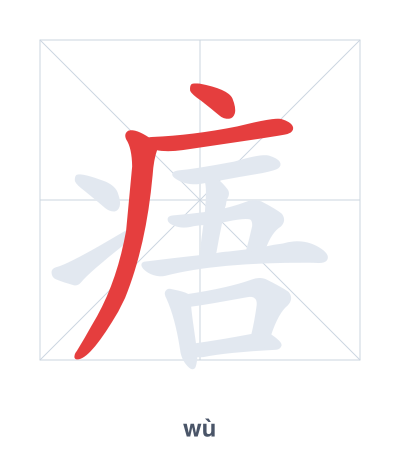
Open Hanzi Writer to see the animated stroke order and practice writing 痦 with real-time feedback.
The character 痦 (wù) is written with 12 strokes. Follow the standard Chinese stroke order: top to bottom, left to right, outside before inside. The radical 疒 is one of its key components.
Practice the correct stroke order with the Hanzi Writer app to see animated stroke-by-stroke guidance with real-time feedback.
痦 means mole.
This character combines the 'illness' radical (疒) with the phonetic component 吾 (wú, meaning 'I' or 'my'). The radical signals a skin condition, while the phonetic hints at pronunciation and can be loosely interpreted as 'my mark'. Together, they depict a mole as a small skin blemish that belongs to oneself.
💡 Memory Tip: Imagine a mole on your face that looks like a tiny mouth (口) with five (五) hairs sprouting from it, all inside a sickly spot (疒).
他鼻子上长了个痦子。
tā bí zi shàng zhǎng le gè wù zi
He has a mole on his nose.
这是一颗黑痦子。
zhè shì yī kē hēi wù zi
This is a black mole.
他的背上长了一个痦子。
tā de bèi shàng zhǎng le yí gè wù zi
He has a mole on his back.
Open Hanzi Writer to see the animated stroke order and practice writing 痦 with real-time feedback.
✨ Animated stroke order · Handwriting recognition · HSK-graded practice · Free to use
The left radical 疒 means "illness" or "disease." The right part 吾 (wú, meaning "I" or "my") gives the pronunciation. Together, they form a phono-semantic compound indicating a skin growth (a mole) that is seen as a minor ailment.