嗡 (wēng) means "Buzz or hum." in Chinese. It has 13 strokes with the radical 口.
Rated 4.2/5 in difficulty (advanced).
Appears in 3+ common words including 嗡嗡 (wēng wēng), 嗡鸣 (wēng míng), 嗡 (wēng).
Due to its 13 strokes, Hanzi Writer's error detection shows 嗡 requires focused practice — most learners need 10+ attempts for consistent accuracy.
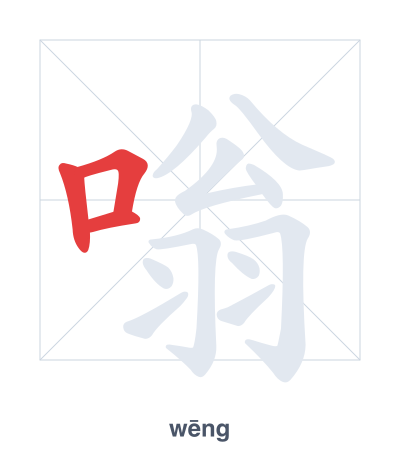
Open Hanzi Writer to see the animated stroke order and practice writing 嗡 with real-time feedback.
The character 嗡 (wēng) is written with 13 strokes. Follow the standard Chinese stroke order: top to bottom, left to right, outside before inside. The radical 口 is one of its key components.
Practice the correct stroke order with the Hanzi Writer app to see animated stroke-by-stroke guidance with real-time feedback.
嗡 means Buzz or hum..
嗡 is a phono-semantic compound: the radical 口 (mouth) indicates that the character relates to sound, while the component 翁 (wēng, meaning 'old man') provides the pronunciation. Together, they evoke the droning, buzzing sound an old man might make while humming, or the buzz of an insect like a bee.
💡 Memory Tip: Imagine an old man (翁) opening his mouth (口) to hum a low, buzzing tune—'wēng wēng wēng.'
蜜蜂嗡嗡地飞。
mì fēng wēng wēng dì fēi
Bees fly with a buzzing sound.
机器有嗡鸣声。
jī qì yǒu wēng míng shēng
The machine is buzzing.
脑子里嗡的一声。
nǎo zi lǐ wēng de yī shēng
One's head started buzzing.
Open Hanzi Writer to see the animated stroke order and practice writing 嗡 with real-time feedback.
✨ Animated stroke order · Handwriting recognition · HSK-graded practice · Free to use
嗡 is composed of the radical 口 (mouth) on the left and 翁 (old man) on the right. The 口 radical indicates that this character relates to sounds, while 翁 provides the pronunciation wēng. Together they represent a buzzing or humming sound made by something like a bee or machine.