薇 (wēi) means "royal fern; vetch" in Chinese. It has 16 strokes with the radical 艹.
Rated 4.2/5 in difficulty (advanced).
Appears in 3+ common words including 蔷薇 (qiáng wēi), 薇菜 (wēi cài), 紫薇 (zǐ wēi).
Due to its 16 strokes, Hanzi Writer's error detection shows 薇 requires focused practice — most learners need 10+ attempts for consistent accuracy.
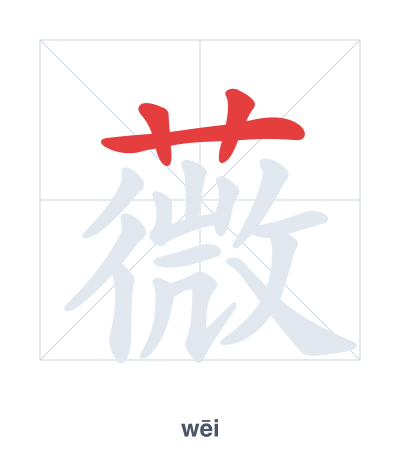
Open Hanzi Writer to see the animated stroke order and practice writing 薇 with real-time feedback.
The character 薇 (wēi) is written with 16 strokes. Follow the standard Chinese stroke order: top to bottom, left to right, outside before inside. The radical 艹 is one of its key components.
Practice the correct stroke order with the Hanzi Writer app to see animated stroke-by-stroke guidance with real-time feedback.
薇 means royal fern; vetch.
薇 is a compound character where the radical 艹 (grass) indicates it is a plant, and the phonetic component 微 (wēi, meaning 'tiny' or 'delicate') suggests the small, fine leaves of the royal fern or vetch. Together, they depict a delicate herbaceous plant.
💡 Memory Tip: Imagine a tiny (微) fern growing among the grass (艹), so small you have to stoop low to see its delicate fronds.
这里的蔷薇很美。
zhè lǐ de qiáng wēi hěn měi
The roses here are very beautiful.
薇菜是一种野菜。
wēi cài shì yī zhǒng yě cài
Royal fern is a type of wild vegetable.
公园里种了紫薇花。
gōng yuán lǐ zhǒng le zǐ wēi huā
Crape myrtles are planted in the park.
Open Hanzi Writer to see the animated stroke order and practice writing 薇 with real-time feedback.
✨ Animated stroke order · Handwriting recognition · HSK-graded practice · Free to use
薇 has the grass radical 艹 on top, showing it is a plant. The lower part 微 (wēi) provides the sound and carries a sense of 'small' or 'delicate,' which fits the fern or vetch plants that are often small and fine.