蔷 (qiáng) means "rose (used in compound words)" in Chinese. It has 14 strokes with the radical 艹.
Rated 4.2/5 in difficulty (advanced).
Appears in 3+ common words including 蔷薇 (qiáng wēi), 蔷薇花 (qiáng wēi huā), 蔷薇色 (qiáng wēi sè).
Due to its 14 strokes, Hanzi Writer's error detection shows 蔷 requires focused practice — most learners need 10+ attempts for consistent accuracy.
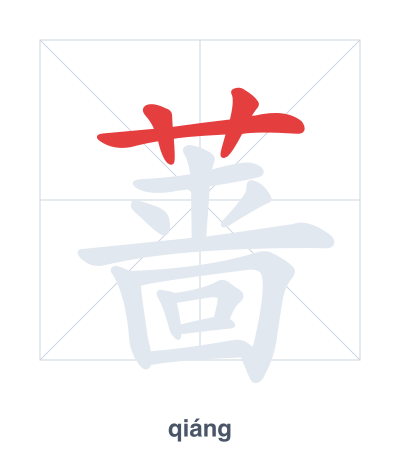
Open Hanzi Writer to see the animated stroke order and practice writing 蔷 with real-time feedback.
The character 蔷 (qiáng) is written with 14 strokes. Follow the standard Chinese stroke order: top to bottom, left to right, outside before inside. The radical 艹 is one of its key components.
Practice the correct stroke order with the Hanzi Writer app to see animated stroke-by-stroke guidance with real-time feedback.
蔷 means rose (used in compound words).
The character 蔷 is a phono-semantic compound. The top radical 艹 (grass) indicates it is a plant, while the bottom component 啬 (sè) provides the sound qiáng and originally depicted a granary or enclosure, suggesting a climbing rose that covers a wall or structure.
💡 Memory Tip: Imagine a rose bush (艹) creeping over a walled enclosure (啬) that looks like a two-story building covered in thorns.
院子里开了蔷薇。
yuàn zi lǐ kāi le qiáng wēi
Roses are blooming in the yard.
蔷薇花真漂亮。
qiáng wēi huā zhēn piào liàng
The roses are really beautiful.
她穿着蔷薇色的裙子。
tā chuān zhe qiáng wēi sè de qún zi
She is wearing a rose-pink skirt.
Open Hanzi Writer to see the animated stroke order and practice writing 蔷 with real-time feedback.
✨ Animated stroke order · Handwriting recognition · HSK-graded practice · Free to use
The character 蔷 combines the grass radical 艹 on top with 啬 (sè) below. The 艹 indicates that the word relates to plants, while 啬 originally provided the sound. Together, they form the character used in words for rose, like 蔷薇.