萎 (wēi/wěi) means "wither; wilt" in Chinese. It has 11 strokes with the radical 艹, and is HSK Level 7.
Rated 4.2/5 in difficulty (advanced).
Harder than 86% of HSK Level 7 characters.
Appears in 3+ common words including 枯萎 (kū wěi), 萎缩 (wēi suō), 萎靡 (wěi mǐ).
Due to its 11 strokes, Hanzi Writer's error detection shows 萎 requires focused practice — most learners need 10+ attempts for consistent accuracy.
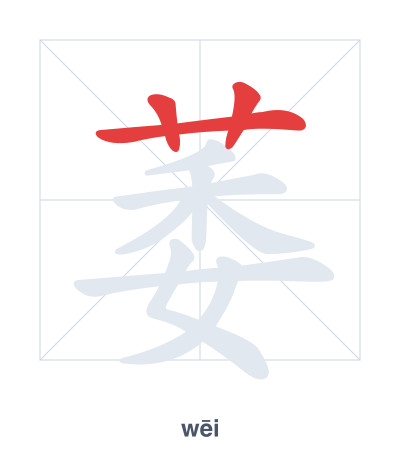
Open Hanzi Writer to see the animated stroke order and practice writing 萎 with real-time feedback.
The character 萎 (wēi/wěi) is written with 11 strokes. Follow the standard Chinese stroke order: top to bottom, left to right, outside before inside. The radical 艹 is one of its key components.
Practice the correct stroke order with the Hanzi Writer app to see animated stroke-by-stroke guidance with real-time feedback.
萎 means wither; wilt.
This is a polyphonic character with readings: wēi, wěi.
As an HSK Level 7 character, 萎 is an intermediate-level character.
This compound character combines the radical 艹 (grass) with 委 (wěi), which provides the sound and also carries the sense of 'bending' or 'drooping'. Together, they depict a plant that has bent over or lost its vitality, representing the meaning 'to wither or wilt.'
💡 Memory Tip: Imagine grass (艹) that is so weak (sounds like 'wēi' as in 'wilt') that it bends and shrivels up.
花朵已经枯萎了。
huā duǒ yǐ jīng kū wěi le
The flowers have already withered.
市场正在萎缩。
shì chǎng zhèng zài wēi suō
The market is shrinking.
他显得精神萎靡。
tā xiǎn de jīng shén wěi mǐ
He looks listless and dispirited.
Open Hanzi Writer to see the animated stroke order and practice writing 萎 with real-time feedback.
✨ Animated stroke order · Handwriting recognition · HSK-graded practice · Free to use
萎 is composed of the grass radical 艹 on top and 委 below. The grass radical connects to plants, while 委 (wěi) itself means "to entrust" but here adds the idea of drooping or decline. Together, they suggest a plant that is losing vitality, which leads to the meaning "wither" or "wilt."