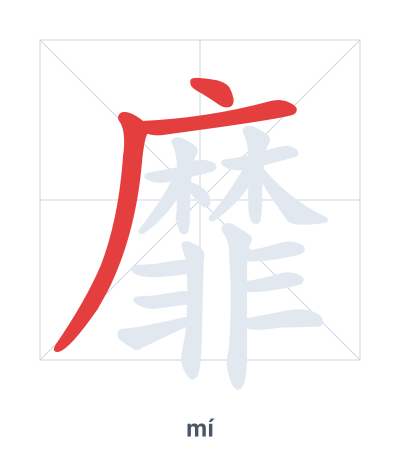
靡 (mí) means "Extravagant; wasteful; withered" in Chinese. It has 19 strokes with the radical 麻. Difficulty: 4.2/5.
Extravagant; wasteful; withered
The character 靡 (mí) is written with 19 strokes. Follow the standard Chinese stroke order: top to bottom, left to right, outside before inside. The radical 麻 is one of its key components.
Practice the correct stroke order with the Hanzi Writer app to see animated stroke-by-stroke guidance with real-time feedback.
靡 is pronounced mí in Mandarin Chinese. It means Extravagant; wasteful; withered.
This is a polyphonic character with readings: mí, mǐ.
这种骄奢淫逸、生活奢靡的风气必须纠正。
zhè zhǒng jiāo shē yín yì shēng huó shē mí de fēng qì bì xū jiū zhèng
This trend of extravagance, debauchery, and luxurious living must be corrected.
这种复古款式的服装最近在年轻人中非常风靡。
zhè zhǒng fù gǔ kuǎn shì de fú zhuāng zuì jìn zài nián qīng rén zhōng fēi cháng fēng mǐ
This vintage-style clothing has become very popular among young people recently.
面对挫折,我们不能情绪委靡,要振作起来。
miàn duì cuò zhé wǒ men bù néng qíng xù wěi mǐ yào zhèn zuò qǐ lái
Facing setbacks, we shouldn't feel dejected; we must cheer up.
Open Hanzi Writer to see the animated stroke order and practice writing 靡 with real-time feedback.