蜿 (wān) means "Winding" in Chinese. It has 14 strokes with the radical 虫.
Rated 4.2/5 in difficulty (advanced).
Appears in 3+ common words including 蜿蜒 (wān yán), 蜿蜒的小路 (wān yán de xiǎo lù), 蜿蜒起伏 (wān yán qǐ fú).
Due to its 14 strokes, Hanzi Writer's error detection shows 蜿 requires focused practice — most learners need 10+ attempts for consistent accuracy.
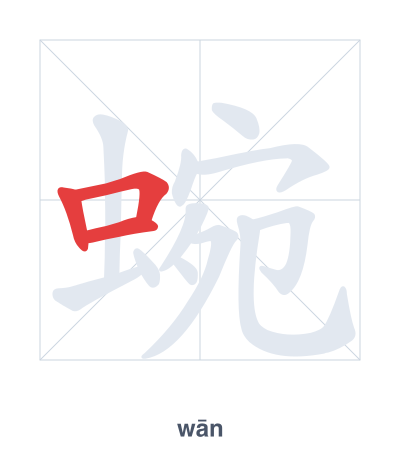
Open Hanzi Writer to see the animated stroke order and practice writing 蜿 with real-time feedback.
The character 蜿 (wān) is written with 14 strokes. Follow the standard Chinese stroke order: top to bottom, left to right, outside before inside. The radical 虫 is one of its key components.
Practice the correct stroke order with the Hanzi Writer app to see animated stroke-by-stroke guidance with real-time feedback.
蜿 means Winding.
The character 蜿 combines the radical 虫 (insect/reptile) with 宛 (wān, meaning winding or crooked). The 宛 component hints at the sinuous movement, and together they depict the twisting, meandering path of a snake or dragon.
💡 Memory Tip: Picture a worm (虫) wiggling in a winding S-shape through the two curves of 宛 to remember 蜿 means winding.
山路蜿蜒向上。
shān lù wān yán xiàng shàng
The mountain road winds upward.
这条小路很蜿蜒。
zhè tiáo xiǎo lù hěn wān yán
This path is very winding.
长城在山间蜿蜒起伏。
cháng chéng zài shān jiān wān yán qǐ fú
The Great Wall winds through the mountains.
Open Hanzi Writer to see the animated stroke order and practice writing 蜿 with real-time feedback.
✨ Animated stroke order · Handwriting recognition · HSK-graded practice · Free to use
The character 蜿 has two parts: the left radical 虫 (insect or snake) and the right part 宛 (wān, meaning winding or curved). The 虫 radical hints at a snake's movement, and 宛 provides both the sound and the idea of curving, together forming the meaning "winding" or "meandering."