暾 (tūn) means "the rising sun" in Chinese. It has 16 strokes with the radical 日.
Rated 4.2/5 in difficulty (advanced).
Appears in 3+ common words including 朝暾 (cháo tūn), 暾暖 (tūn nuǎn), 暾暾 (tūn tūn).
Due to its 16 strokes, Hanzi Writer's error detection shows 暾 requires focused practice — most learners need 10+ attempts for consistent accuracy.
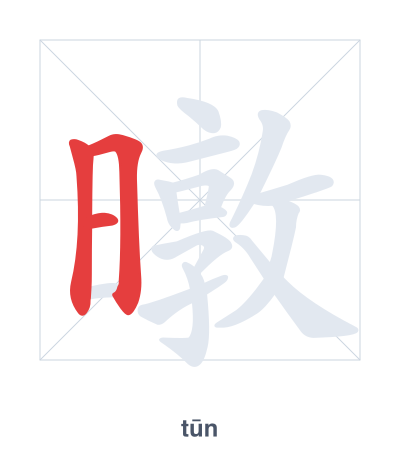
Open Hanzi Writer to see the animated stroke order and practice writing 暾 with real-time feedback.
The character 暾 (tūn) is written with 16 strokes. Follow the standard Chinese stroke order: top to bottom, left to right, outside before inside. The radical 日 is one of its key components.
Practice the correct stroke order with the Hanzi Writer app to see animated stroke-by-stroke guidance with real-time feedback.
暾 means the rising sun.
暾 is a phono-semantic compound character. The radical 日 (sun) indicates its association with sunlight or daytime, while the phonetic component 敦 (dūn, meaning 'sincere' or 'earnest') provides the sound and also suggests the honest, steady glow of dawn. Together, they depict the rising sun's bright and promising light at daybreak.
💡 Memory Tip: Picture the sun (日) earnestly pushing aside the night with a sincere (敦) burst of light—that's the rising sun (暾).
朝暾照在大地上。
cháo tūn zhào zài dà dì shàng
The morning sun shines on the earth.
阳光暾暖很舒服。
yáng guāng tūn nuǎn hěn shū fú
The warm morning sunlight is very comfortable.
太阳暾暾地升起。
tài yáng tūn tūn dì shēng qǐ
The sun rises with a bright, warm glow.
Open Hanzi Writer to see the animated stroke order and practice writing 暾 with real-time feedback.
✨ Animated stroke order · Handwriting recognition · HSK-graded practice · Free to use
The character 暾 is made of two parts: the left side is the radical 日 (sun), which gives the meaning of sunlight or sun. The right side is 敦 (dūn), which provides the pronunciation. Together, they form the idea of 'the rising sun' because the sun radical is combined with a phonetic component.