暝 (míng) means "dark; dusk; nightfall" in Chinese. It has 14 strokes with the radical 日.
Rated 4.2/5 in difficulty (advanced).
Appears in 3+ common words including 晦暝 (huì míng), 暝色 (míng sè), 幽暝 (yōu míng).
Due to its 14 strokes, Hanzi Writer's error detection shows 暝 requires focused practice — most learners need 10+ attempts for consistent accuracy.
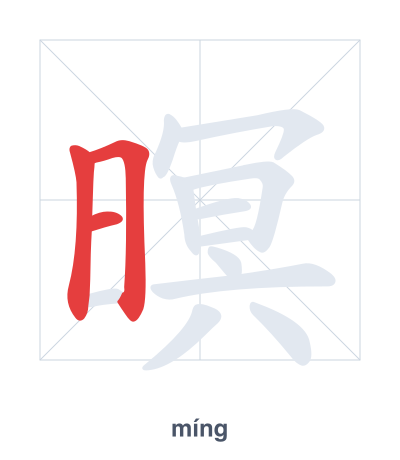
Open Hanzi Writer to see the animated stroke order and practice writing 暝 with real-time feedback.
The character 暝 (míng) is written with 14 strokes. Follow the standard Chinese stroke order: top to bottom, left to right, outside before inside. The radical 日 is one of its key components.
Practice the correct stroke order with the Hanzi Writer app to see animated stroke-by-stroke guidance with real-time feedback.
暝 means dark; dusk; nightfall.
暝 combines the sun radical 日 with 冥, which itself depicts a cover (冖) over the sun (日) and a person (大), literally 'the sun covered' → darkness. Together, 暝 means dusk or nightfall when the sun is hidden.
💡 Memory Tip: As the sun (日) sinks under a big cover (冥), the world grows dark — that's 暝, the moment day turns into night.
天色变得晦暝。
tiān sè biàn dé huì míng
The sky has become dark and gloomy.
暝色笼罩了大地。
míng sè lǒng zhào le dà dì
Twilight enveloped the earth.
森林里很幽暝。
sēn lín lǐ hěn yōu míng
The forest is very dark and dim.
Open Hanzi Writer to see the animated stroke order and practice writing 暝 with real-time feedback.
✨ Animated stroke order · Handwriting recognition · HSK-graded practice · Free to use
暝 is composed of the radical 日 (sun) on the left and 冥 (dark, dim) on the right. The sun component suggests a time related to daylight, while 冥 adds the meaning of darkness, together creating the idea of dusk or nightfall when the sun is gone. This structure makes 暝 a compound character where both parts contribute to the meaning of 'dark' and 'twilight'.