暡 (wěng) means "dim; cloudy; obscure" in Chinese. It has 14 strokes with the radical 日.
Rated 4.2/5 in difficulty (advanced).
Appears in 3+ common words including 暡暡 (wěng wěng), 暡翳 (wěng yì), 暡朦 (wěng méng).
Due to its 14 strokes, Hanzi Writer's error detection shows 暡 requires focused practice — most learners need 10+ attempts for consistent accuracy.
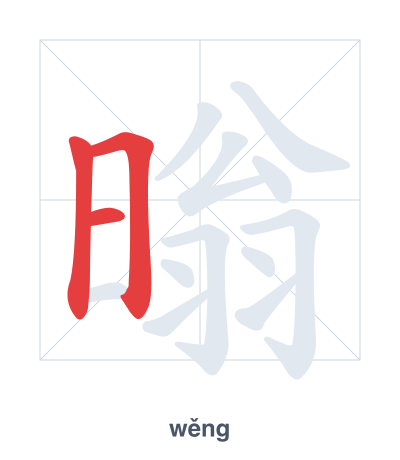
Open Hanzi Writer to see the animated stroke order and practice writing 暡 with real-time feedback.
The character 暡 (wěng) is written with 14 strokes. Follow the standard Chinese stroke order: top to bottom, left to right, outside before inside. The radical 日 is one of its key components.
Practice the correct stroke order with the Hanzi Writer app to see animated stroke-by-stroke guidance with real-time feedback.
暡 means dim; cloudy; obscure.
暡 is a phono-semantic compound: the radical 日 (sun) suggests meaning related to light or sky, while 翁 (wěng, 'old man') provides the sound. Together, the character conveys the sense of the sun being dimmed or obscured, like a cloudy sky that makes everything hazy and unclear.
💡 Memory Tip: Picture an old man (翁) squinting up at the sun (日) through thick clouds, finding it dim and obscure.
天色暡暡的。
tiān sè wěng wěng de
The sky is dim and hazy.
云层暡翳了阳光。
yún céng wěng yì le yáng guāng
The cloud layer dimmed the sunlight.
视线有些暡朦。
shì xiàn yǒu xiē wěng méng
The line of sight is a bit hazy.
Open Hanzi Writer to see the animated stroke order and practice writing 暡 with real-time feedback.
✨ Animated stroke order · Handwriting recognition · HSK-graded practice · Free to use
The character 暡 is made of two parts: the radical 日 (sun/day) on the left, and 翁 (wěng, meaning 'old man') on the right. The 日 part suggests the meaning relates to the sun or sky, while 翁 provides the pronunciation and hints at covering or obscuring, combined giving the idea of dimness or cloudiness.