瞳 (tóng) means "pupil (of the eye)" in Chinese. It has 17 strokes with the radical 目.
Rated 4.2/5 in difficulty (advanced).
Appears in 3+ common words including 瞳孔 (tóng kǒng), 瞳仁 (tóng rén), 瞳神 (tóng shén).
Due to its 17 strokes, Hanzi Writer's error detection shows 瞳 requires focused practice — most learners need 10+ attempts for consistent accuracy.
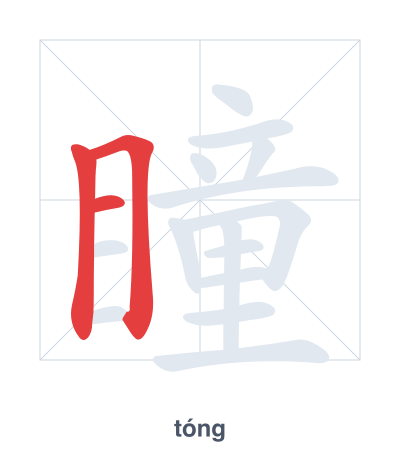
Open Hanzi Writer to see the animated stroke order and practice writing 瞳 with real-time feedback.
The character 瞳 (tóng) is written with 17 strokes. Follow the standard Chinese stroke order: top to bottom, left to right, outside before inside. The radical 目 is one of its key components.
Practice the correct stroke order with the Hanzi Writer app to see animated stroke-by-stroke guidance with real-time feedback.
瞳 means pupil (of the eye).
瞳 combines the radical 目 (eye) with 童 (child). The pupil is like a tiny child mirrored in the eye, as ancient Chinese noted the small reflection of oneself seen in another's pupil.
💡 Memory Tip: Imagine a child (童) peeking out from inside your eye (目) — that tiny face is the pupil.
医生检查他的瞳孔。
yī shēng jiǎn chá tā de tóng kǒng
The doctor checked his pupils.
她的瞳仁很黑。
tā de tóng rén hěn hēi
Her pupils are very dark.
他的瞳神很有光。
tā de tóng shén hěn yǒu guāng
His pupils are very bright and full of life.
Open Hanzi Writer to see the animated stroke order and practice writing 瞳 with real-time feedback.
✨ Animated stroke order · Handwriting recognition · HSK-graded practice · Free to use
The character 瞳 is composed of the radical 目 (eye) on the left and the phonetic component 童 (tóng, child) on the right. The eye radical indicates that the character relates to the eye, and the right side gives the pronunciation while also suggesting that the pupil is like a small child looking out.