倜 (tì) means "unrestrained / free and easy" in Chinese. It has 10 strokes with the radical 亻.
Rated 3.9/5 in difficulty (challenging).
Appears in 3+ common words including 倜傥 (tì tǎng), 举止倜傥 (jǔ zhǐ tì tǎng), 倜然 (tì rán).
Due to its 10 strokes, Hanzi Writer's error detection shows 倜 requires focused practice — most learners need 10+ attempts for consistent accuracy.
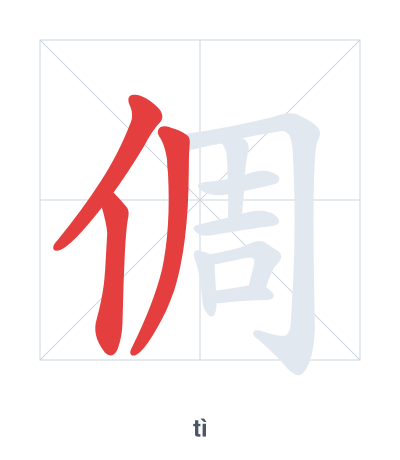
Open Hanzi Writer to see the animated stroke order and practice writing 倜 with real-time feedback.
The character 倜 (tì) is written with 10 strokes. Follow the standard Chinese stroke order: top to bottom, left to right, outside before inside. The radical 亻 is one of its key components.
Practice the correct stroke order with the Hanzi Writer app to see animated stroke-by-stroke guidance with real-time feedback.
倜 means unrestrained / free and easy.
倜 combines the person radical 亻 with 周 (zhōu, meaning 'all around' or 'thorough'). This suggests a person who is at ease in all directions or circumstances, hence 'unrestrained and free and easy.'
💡 Memory Tip: Imagine a person (亻) who can freely walk around (周) anywhere without any constraints.
他为人风流倜傥。
tā wéi rén fēng liú tì tǎng
He is elegant and unrestrained.
他的举止很倜傥。
tā de jǔ zhǐ hěn tì tǎng
His manner is elegant and unrestrained.
他表现得倜然不群。
tā biǎo xiàn dé tì rán bù qún
He behaved in an outstanding and unconventional manner.
Open Hanzi Writer to see the animated stroke order and practice writing 倜 with real-time feedback.
✨ Animated stroke order · Handwriting recognition · HSK-graded practice · Free to use
The character 倜 combines the radical 亻 (person) on the left with 周 (zhōu) on the right. The radical suggests the meaning relates to a person's behavior or character, while 周 adds the sound and hints at completeness, together forming the idea of a person who is unrestrained and free in manner.