唢 (suǒ) means "Suona (musical instrument)" in Chinese. It has 10 strokes with the radical 口.
Rated 4.2/5 in difficulty (advanced).
Appears in 3+ common words including 唢呐 (suǒ nà), 吹唢呐 (chuī suǒ nà), 唢呐声 (suǒ nà shēng).
Due to its 10 strokes, Hanzi Writer's error detection shows 唢 requires focused practice — most learners need 10+ attempts for consistent accuracy.
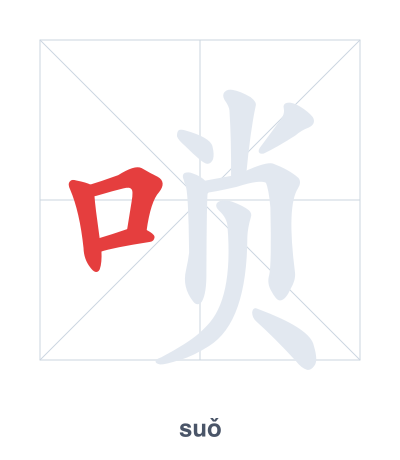
Open Hanzi Writer to see the animated stroke order and practice writing 唢 with real-time feedback.
The character 唢 (suǒ) is written with 10 strokes. Follow the standard Chinese stroke order: top to bottom, left to right, outside before inside. The radical 口 is one of its key components.
Practice the correct stroke order with the Hanzi Writer app to see animated stroke-by-stroke guidance with real-time feedback.
唢 means Suona (musical instrument).
唢 is a compound character where the left radical 口 (mouth) indicates that the character relates to sound or wind instruments, and the right component 索 (suǒ) provides the pronunciation. Together, they form the name of the suona, a loud Chinese woodwind instrument played with the mouth.
💡 Memory Tip: Imagine a musician tying a rope (索) from his mouth (口) to a suona so he doesn't drop it while blowing vigorously.
他在吹唢呐。
tā zài chuī suǒ nà
He is playing the suona.
爷爷喜欢吹唢呐。
yé yé xǐ huān chuī suǒ nà
Grandpa likes playing the suona.
唢呐声很大。
suǒ nà shēng hěn dà
The sound of the suona is very loud.
Open Hanzi Writer to see the animated stroke order and practice writing 唢 with real-time feedback.
✨ Animated stroke order · Handwriting recognition · HSK-graded practice · Free to use
唢 is composed of the mouth radical 口 on the left and the phonetic component 索 (suǒ) on the right. The 口 suggests the character relates to sound or mouth actions, while 索 provides the pronunciation clue.”