呐 (nà) means "to shout; (particle)" in Chinese. It has 7 strokes with the radical 口, and is HSK Level 7.
Rated 3.5/5 in difficulty (challenging).
Harder than 15% of HSK Level 7 characters.
Appears in 3+ common words including 呐喊 (nà hǎn), 唢呐 (suǒ nà), 呐呐 (nà nà).
Due to its 7 strokes, Hanzi Writer's error detection shows 呐 requires focused practice — most learners need 10+ attempts for consistent accuracy.
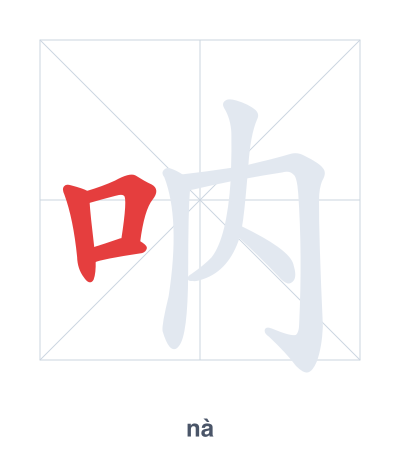
Open Hanzi Writer to see the animated stroke order and practice writing 呐 with real-time feedback.
The character 呐 (nà) is written with 7 strokes. Follow the standard Chinese stroke order: top to bottom, left to right, outside before inside. The radical 口 is one of its key components.
Practice the correct stroke order with the Hanzi Writer app to see animated stroke-by-stroke guidance with real-time feedback.
呐 means to shout; (particle).
As an HSK Level 7 character, 呐 is an intermediate-level character.
呐 is a phono-semantic compound combining 口 (mouth, indicating speech) with 内 (inside, providing pronunciation). The original meaning was 'to shout'—opening the mouth to project sound inward or outward.
💡 Memory Tip: Picture a mouth (口) shouting so loudly that the sound goes right inside (内) your ears.
观众在大声呐喊。
guān zhòng zài dà shēng nà hǎn
The audience is shouting loudly.
他在吹唢呐。
tā zài chuī suǒ nà
He is playing the suona.
他呐呐地说了几句。
tā nà nà dì shuō le jǐ jù
He mumbled a few words.
Open Hanzi Writer to see the animated stroke order and practice writing 呐 with real-time feedback.
✨ Animated stroke order · Handwriting recognition · HSK-graded practice · Free to use
呐 is made of two parts: the radical 口 (mouth) on the left and 内 (inside) on the right. The 口 radical indicates that the character is related to speech or sound, while 内 suggests shouting from inside. Together, they form the idea of a shout or cry coming from within.