艘 (sōu) means "Classifier for ships" in Chinese. It has 15 strokes with the radical 舟, and is HSK Level 7.
Rated 4.2/5 in difficulty (advanced).
Harder than 85% of HSK Level 7 characters.
Appears in 3+ common words including 一艘船 (yì sōu chuán), 两艘舰 (liǎng sōu jiàn), 艘数 (sōu shù).
Due to its 15 strokes, Hanzi Writer's error detection shows 艘 requires focused practice — most learners need 10+ attempts for consistent accuracy.
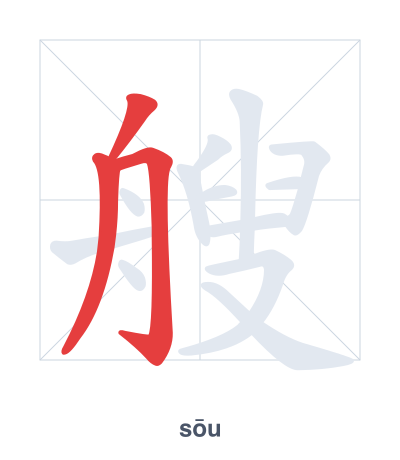
Open Hanzi Writer to see the animated stroke order and practice writing 艘 with real-time feedback.
The character 艘 (sōu) is written with 15 strokes. Follow the standard Chinese stroke order: top to bottom, left to right, outside before inside. The radical 舟 is one of its key components.
Practice the correct stroke order with the Hanzi Writer app to see animated stroke-by-stroke guidance with real-time feedback.
艘 means Classifier for ships.
As an HSK Level 7 character, 艘 is an intermediate-level character.
艘 combines the radical 舟 (boat) with 叟 (sǒu, old man), which gives the sound. The ancient form of 舟 depicted a boat's shape, and 叟 adds phonetic value, so the character means 'a vessel' and is used as a classifier for ships.
💡 Memory Tip: Picture an old man (叟) sitting on a boat (舟) counting each ship as 'one 艘, two 艘'.
海平面上出现了一艘船,正慢慢向港口驶来。
hǎi píng miàn shàng chū xiàn le yì sōu chuán , zhèng màn màn xiàng gǎng kǒu shǐ lái 。
A ship appeared on the horizon and is slowly sailing toward the port.
那是两艘舰,正在海面上进行协同演习。
nà shì liǎng sōu jiàn , zhèng zài hǎi miàn shàng jìn xíng xié tóng yǎn xí 。
Those are two warships conducting joint exercises on the sea.
统计船舶的艘数。
tǒng jì chuán bó de sōu shù
Count the number of ships.
Open Hanzi Writer to see the animated stroke order and practice writing 艘 with real-time feedback.
✨ Animated stroke order · Handwriting recognition · HSK-graded practice · Free to use
The character 艘 is composed of the radical 舟 (boat) on the left, which hints at its meaning related to ships. The right part 叟 (sǒu, old man) provides the sound and originally meant 'old man', but here it functions purely as a phonetic component.