艅 (yú) means "Ancient boat type" in Chinese. It has 13 strokes with the radical 舟.
Rated 4.2/5 in difficulty (advanced).
Appears in 3+ common words including 艅艎 (yú huáng), 艅舟 (yú zhōu), 乘艅 (chéng yú).
Due to its 13 strokes, Hanzi Writer's error detection shows 艅 requires focused practice — most learners need 10+ attempts for consistent accuracy.
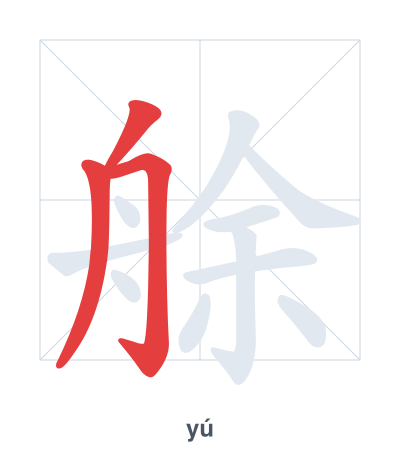
Open Hanzi Writer to see the animated stroke order and practice writing 艅 with real-time feedback.
The character 艅 (yú) is written with 13 strokes. Follow the standard Chinese stroke order: top to bottom, left to right, outside before inside. The radical 舟 is one of its key components.
Practice the correct stroke order with the Hanzi Writer app to see animated stroke-by-stroke guidance with real-time feedback.
艅 means Ancient boat type.
艅 is a phono-semantic compound. The radical 舟 (boat) indicates the meaning relates to watercraft, while the phonetic component 余 (yú) gives the pronunciation and hints at surplus or grandeur, as this character refers to a large, ancient boat often used by nobility.
💡 Memory Tip: Imagine a boat (舟) with a surplus (余) of space and decorations, making it an ancient luxury yacht.
艅艎在湖中行驶。
yú huáng zài hú zhōng háng shǐ
The ancient warship is sailing in the lake.
艅舟在水面漂浮。
yú zhōu zài shuǐ miàn piāo fú
The ancient boat is floating on the water.
诗人乘艅游湖。
shī rén chéng yú yóu hú
The poet took a boat to tour the lake.
Open Hanzi Writer to see the animated stroke order and practice writing 艅 with real-time feedback.
✨ Animated stroke order · Handwriting recognition · HSK-graded practice · Free to use
艅 is made of the radical 舟 (boat) on the left and 余 (yú, meaning 'surplus' or 'remainder') on the right. The 舟 radical indicates that the character refers to a type of boat, while 余 acts as a phonetic component giving the pronunciation yú. Together, they form the meaning of an ancient vessel.