舣 (yǐ) means "to moor a boat" in Chinese. It has 9 strokes with the radical 舟.
Rated 4/5 in difficulty (challenging).
Appears in 3+ common words including 舣舟 (yǐ zhōu), 舣泊 (yǐ pō), 舣岸 (yǐ àn).
Due to its 9 strokes, Hanzi Writer's error detection shows 舣 requires focused practice — most learners need 10+ attempts for consistent accuracy.
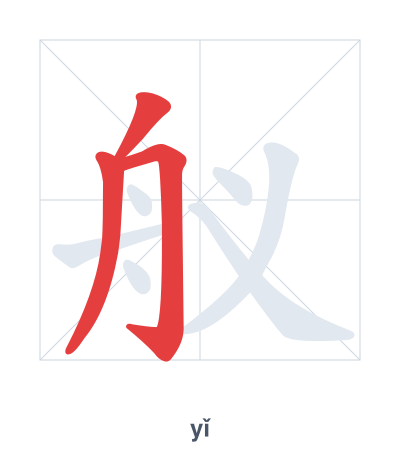
Open Hanzi Writer to see the animated stroke order and practice writing 舣 with real-time feedback.
The character 舣 (yǐ) is written with 9 strokes. Follow the standard Chinese stroke order: top to bottom, left to right, outside before inside. The radical 舟 is one of its key components.
Practice the correct stroke order with the Hanzi Writer app to see animated stroke-by-stroke guidance with real-time feedback.
舣 means to moor a boat.
舣 is a phono-semantic compound: the radical 舟 (boat) indicates the meaning related to boats, while the component 义 (yì) provides the pronunciation. Together they represent the action of mooring a boat, as in tying it to a dock.
💡 Memory Tip: Picture a boat (舟) with a giant 'X' (义) shaped mooring pole you wrap the rope around to secure it.
船夫在岸边舣舟。
chuán fū zài àn biān yǐ zhōu
The boatman is mooring the boat by the shore.
船只在码头舣泊。
chuán zhī zài mǎ tóu yǐ pō
The vessel is moored at the dock.
小船正在舣岸。
xiǎo chuán zhèng zài yǐ àn
The small boat is docking.
Open Hanzi Writer to see the animated stroke order and practice writing 舣 with real-time feedback.
✨ Animated stroke order · Handwriting recognition · HSK-graded practice · Free to use
舣 is composed of the radical 舟 (boat) on the left and the phonetic component 义 (yì) on the right. The radical gives the meaning of "boat," while the sound from 义 helps with pronunciation. Together, they create the idea of handling a boat—specifically mooring it.