舭 (bǐ) means "bilge (of a ship)" in Chinese. It has 10 strokes with the radical 舟.
Rated 4.2/5 in difficulty (advanced).
Appears in 3+ common words including 舭部 (bǐ bù), 舭龙骨 (bǐ lóng gǔ), 船舭 (chuán bǐ).
Due to its 10 strokes, Hanzi Writer's error detection shows 舭 requires focused practice — most learners need 10+ attempts for consistent accuracy.
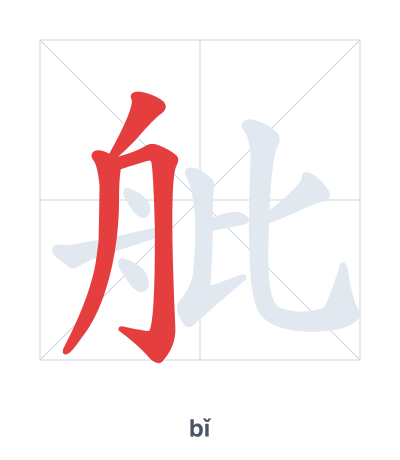
Open Hanzi Writer to see the animated stroke order and practice writing 舭 with real-time feedback.
The character 舭 (bǐ) is written with 10 strokes. Follow the standard Chinese stroke order: top to bottom, left to right, outside before inside. The radical 舟 is one of its key components.
Practice the correct stroke order with the Hanzi Writer app to see animated stroke-by-stroke guidance with real-time feedback.
舭 means bilge (of a ship).
舭 is a phono-semantic compound: the radical 舟 (boat) indicates the meaning relates to ships, while 比 (bǐ) provides the pronunciation. The bilge is the lowest inner part of a ship's hull, where water and waste collect, hence the association with the boat radical.
💡 Memory Tip: Picture two people (比) standing in the bottom of a boat (舟), comparing who has wetter feet from the bilge water.
船的舭部在水下。
chuán de bǐ bù zài shuǐ xià
The bilge of the ship is underwater.
这艘船有舭龙骨。
zhè sōu chuán yǒu bǐ lóng gǔ
This ship has bilge keels.
船舭需要定期检查。
chuán bǐ xū yào dìng qī jiǎn chá
The ship's bilge needs regular inspection.
Open Hanzi Writer to see the animated stroke order and practice writing 舭 with real-time feedback.
✨ Animated stroke order · Handwriting recognition · HSK-graded practice · Free to use
舭 is a left-right structure. The left component 舟 (boat/ship) hints that the character relates to water vessels. The right component 比 (bǐ) provides the sound and adds a sense of comparison or side-by-side, reflecting the bilge as the side area inside a ship's hull.